 Nourmio
How to read a US Nutrition Facts label for food logging
Choose the right label column, scale calories and nutrient grams to what you ate, and check a barcode result without double-counting sugar.
To log food from a US Nutrition Facts label, first identify the serving or package column. Work out how much of that amount you ate, then scale the calories and nutrient grams by the same factor. Total carbohydrate, total sugar and added sugar are different lines.
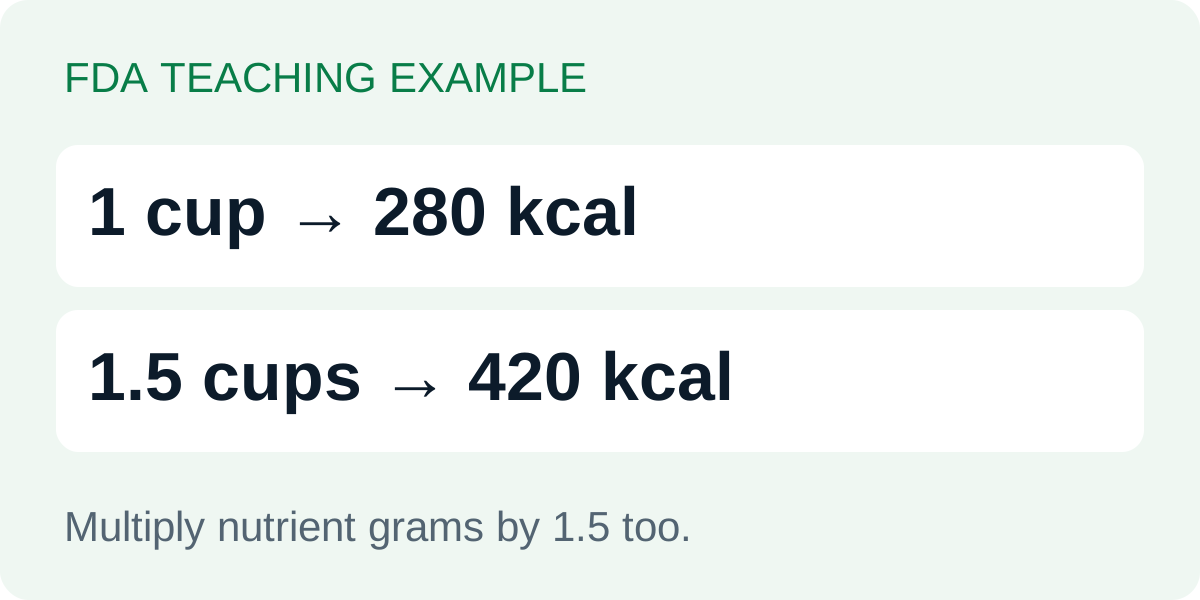
Programmatically drawn explanatory diagram. The examples and source limitations are explained below.
Read the top of the label before the numbers
Start with the serving size and servings per container. A serving might be a cup, a number of pieces or an amount in grams. Some packages show a second column for the whole container.
Choose the column for the amount you are calculating. If you use a whole-container value, do not multiply it by the number of servings again. FDA also explains that the printed serving size describes customary consumption. It is not an instruction for how much you should eat.
Scale a real FDA teaching example
FDA’s sample lasagna label lists one cup, 227 g, as one serving. It gives 280 calories, 34 g total carbohydrate, 6 g total sugar and 0 g added sugar per serving. This is FDA’s teaching example, not a claim about a particular lasagna you bought.
Suppose you eat 1.5 cups of that example food. Your multiplier is 1.5. The corresponding mass is 340.5 g, assuming the cups match the example.
| Quantity | One label serving | 1.5 servings |
|---|---|---|
| Calories | 280 kcal | 420 kcal |
| Total carbohydrate | 34 g | 51 g |
| Total sugar | 6 g | 9 g |
| Added sugar | 0 g | 0 g |
The 9 g of total sugar is already inside the 51 g of carbohydrate. Do not add those figures together. Added sugar, when present, is also part of total sugar.
Copy grams, not the percent sign
The percent Daily Value is a reference percentage. It is not the number of grams you ate. For logging, read the gram value next to the nutrient and apply your portion multiplier.
The “Includes” line for added sugar describes part of the total-sugar amount. Our total versus added sugar guide explains that relationship and includes a practice exercise.
Nourmio records total sugar from information you enter or confirm. It does not split added and naturally occurring sugars. Check the field’s serving basis when entering it. In a per-100 g field, enter the value for 100 g and set your portion separately. Do not put the whole portion’s sugar amount into that per-100 g field.
Check whether the food is sold dry or prepared
Look for instructions such as “as packaged” and “as prepared.” A prepared value may include milk, oil or another ingredient named in the directions.
If you used a different ingredient or amount, that prepared value may not describe your food. Calculate from the packaged food and the ingredients you actually used, or find a matching prepared entry. Avoid logging the prepared meal and its already included ingredients a second time.
Read a barcode result against the package
A barcode lookup can find a product record. Check its brand, variety, serving size and nutrition against the package in your hand. A similar name does not establish that it is the same recipe or market version.
If the result uses values per 100 g, keep that basis when entering the nutrition. Your portion is a separate amount. A value for a 40 g serving should not be entered as though it described 100 g.
Practice reading the sugar lines
Practice with three invented label excerpts below. The exercise checks total and added sugar separately. For calories and other nutrients, apply the same portion multiplier as in the lasagna example above.
Keep the source with the entry
Before saving, ask whether the food, nutrient basis and amount eaten describe the same item. If something is missing, check the package rather than replacing an unknown number with zero.
You can enter label information manually in Nourmio and review a scanned result before saving. The homemade-meal calculation helps when your food combines several labeled ingredients.