 Nourmio
Sugar alcohol vs. added sugar on a Nutrition Facts label
Read Sugar Alcohol, Total Sugars and Includes Added Sugars as different label fields. A worked example shows which values to scale and which not to subtract.
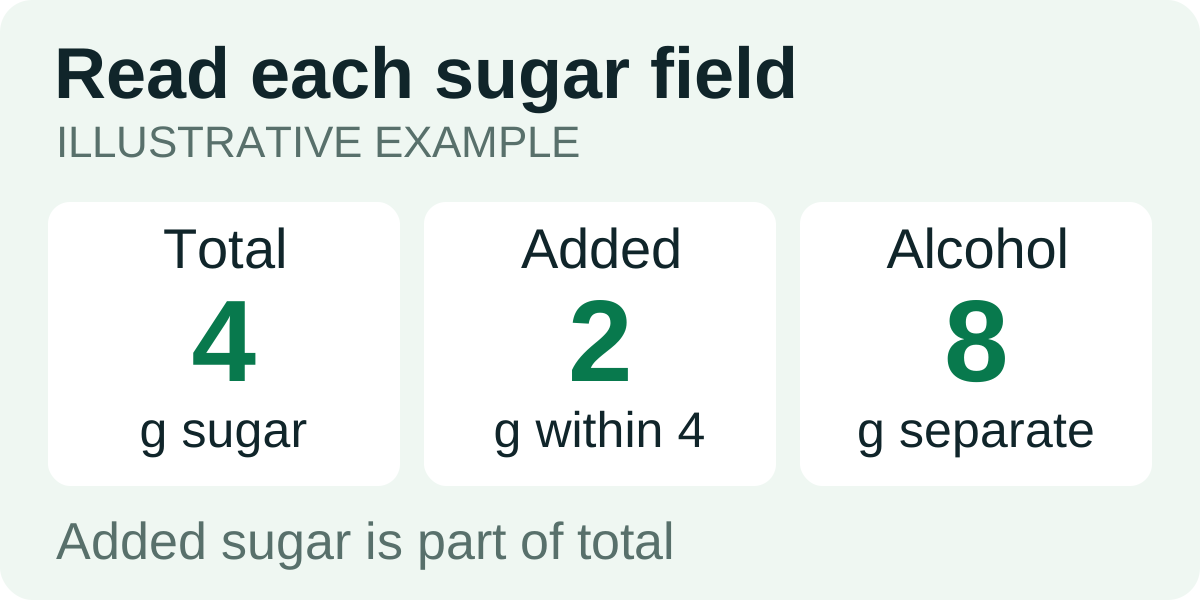
Sugar alcohols and added sugars are different label categories. Includes Added Sugars is part of Total Sugars. A Sugar Alcohol line, when present, is separate and must not be subtracted from Total Sugars to find added sugar. Read the ingredients and scale each declared amount to the portion you eat.
Start with the names on the panel
On a US Nutrition Facts panel, Total Sugars and Includes Added Sugars answer related questions. Sugar Alcohol answers another one. Similar words do not make these interchangeable entries.
FDA lists erythritol, maltitol, sorbitol and xylitol among sugar alcohols. Despite the name, these are not the beverage alcohol in beer or wine. You may find one of those ingredient names even when the panel does not display a separate sugar-alcohol total.
The FDA generally lets manufacturers omit the sugar-alcohol line. Certain claims on the package make the declaration mandatory. A product with just one sugar alcohol may list it by name, such as “xylitol.” If you see a name only in the ingredient list, you know it’s present, but the list doesn’t tell you how many grams are in a serving.
Keep the three amounts separate
Consider these selected fields from a hypothetical US label for a 40 g portion. This is a teaching example, not a product label or a nutrition recommendation.
| Label field | Per 40 g serving | What the number means here |
|---|---|---|
| Calories | 120 kcal | The label’s stated energy for that serving |
| Total Carbohydrate | 24 g | The broader carbohydrate amount |
| Dietary Fiber | 5 g | A separate declared carbohydrate field |
| Total Sugars | 4 g | The serving’s declared total sugars |
| Includes Added Sugars | 2 g | Already included within the 4 g total |
| Sugar Alcohol | 8 g | A separate amount, not 8 g added sugar |
Do not add 4 + 2 and log 6 g total sugar. The example’s total is 4 g. Do not subtract 8 from 4 either. A negative result would signal that you have combined fields that do not have that relationship.
You also cannot reconstruct the product’s calories by treating every carbohydrate line as another ingredient. Some fields overlap. Use the panel’s Calories value, scaled to your portion, rather than changing it to make an improvised formula fit.
Scale the portion without changing the categories
If you eat 60 g of the example product, that is 60 ÷ 40 = 1.5 label servings. Multiply each value by 1.5 independently.
| Amount in 60 g | Calculation | Result |
|---|---|---|
| Calories | 120 × 1.5 | 180 kcal |
| Total sugar | 4 × 1.5 | 6 g |
| Added sugar | 2 × 1.5 | 3 g, included in the total |
| Sugar alcohol | 8 × 1.5 | 12 g, kept separate |
Those figures are proportional estimates from rounded label data. They are not laboratory measurements of the portion.
This guide does not calculate “net carbs,” a treatment dose or a blood-glucose response. The printed categories alone cannot determine those outcomes for a person. It also does not tell you that a sugar-free product has no calories. For the package wording, see sugar-free, no added sugar and unsweetened.
Enter what your diary actually records
For Nourmio’s calorie and total-sugar entry, use the example portion’s 180 kcal and 6 g total sugar. Do not put its 12 g sugar alcohol into the sugar field, and do not replace total sugar with the 3 g added-sugar figure.
If a barcode result does not match the package’s serving size or fields, check and correct it before saving. Keep any separate added-sugar or sugar-alcohol information in your own notes where needed.