 Nourmio
How to count calories in homemade meals
Calculate a homemade recipe and your portion using matched ingredient data, finished food weight and a worked USDA example.
To count calories in a homemade meal, calculate the calories in the ingredients that remain in the dish. For an evenly mixed batch, multiply that total by your portion weight divided by the finished food weight. You need weights that describe the same food at the same stage, plus nutrition data that match each ingredient.
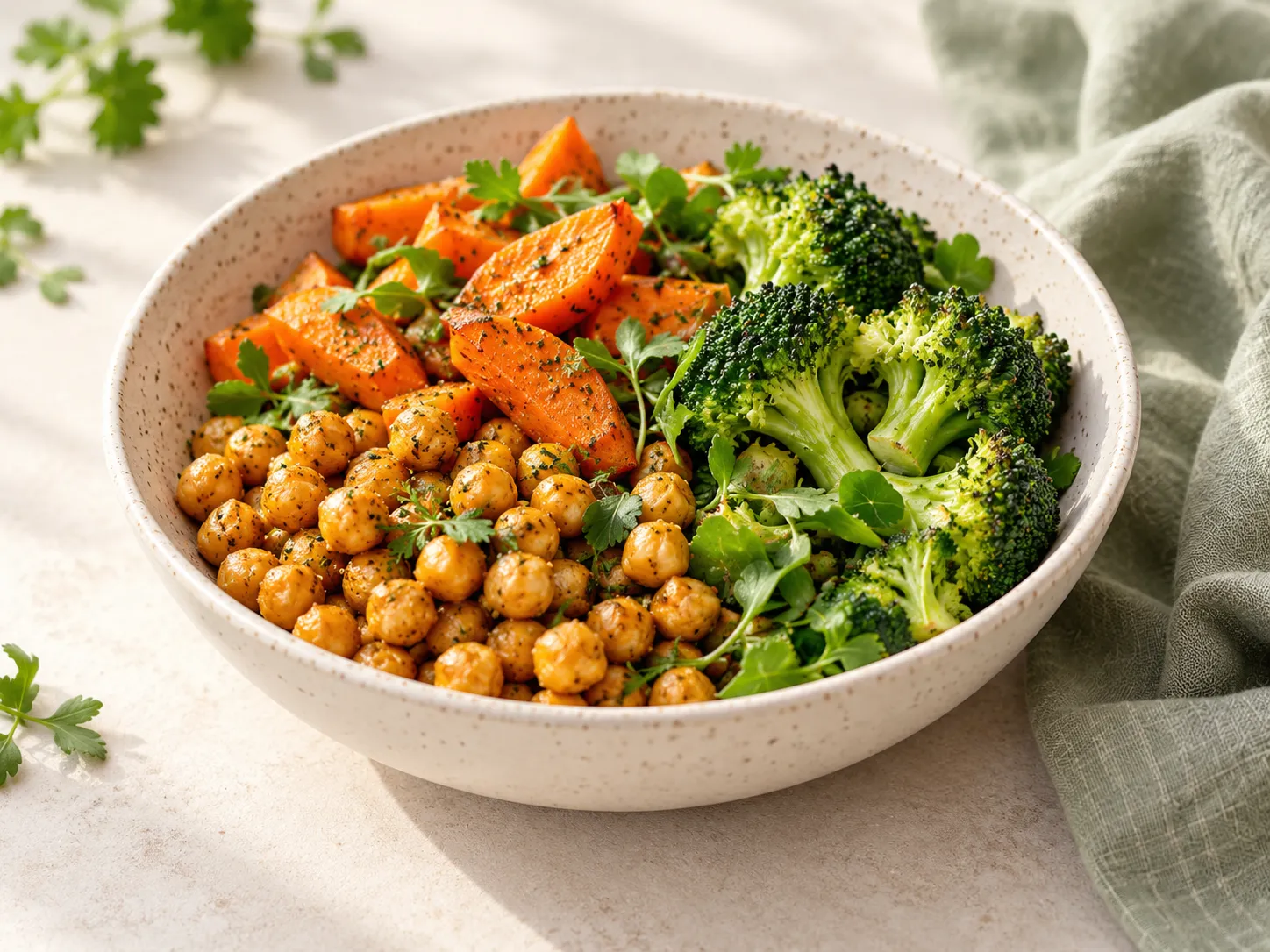
AI-generated editorial illustration. It does not show a measured serving or an app result.
Match the ingredient before using the number
Record the edible amount you put into the dish. For a packaged ingredient, use the label on the package you actually used. For a basic food, look for an appropriate food-composition record such as USDA FoodData Central. Include oil, sauce and toppings.
Raw and cooked are not interchangeable descriptions. Use a cooked-chickpea entry for chickpeas weighed after boiling. Dry chickpeas need a dry entry. With canned food, check whether the entry includes liquid or describes drained solids.
If a label gives calories per serving, multiply those calories by the amount you used divided by the label’s serving amount. For database values per 100 g, multiply the grams used by the calorie value and divide by 100.
Calculate one whole batch
The following is a hypothetical chickpea-and-vegetable example, not a recipe we cooked and measured. Ingredient amounts are chosen for the calculation. Calorie values are from these USDA SR Legacy records, checked October 27, 2026.
| Ingredient | Amount | kcal per 100 g | kcal added |
|---|---|---|---|
| Cooked, boiled chickpeas without salt, FDC 173757 | 250 g | 164 | 410 |
| Raw carrots, FDC 170393 | 150 g | 41 | 61.5 |
| Raw broccoli, FDC 170379 | 200 g | 34 | 68 |
| Olive oil, FDC 171413 | 10 g | 884 | 88.4 |
| Total | 627.9 |
The model assumes all of the oil and other calorie-containing ingredients stay in the finished food. If you discard sauce, rendered fat or other ingredients, the starting total may not describe what remains. Without knowing what was discarded and how much, any calorie adjustment is an estimate.
Calculate the portion you ate
Suppose the finished batch weighs 600 g and your serving weighs 180 g. Those two weights are assumptions for this example. They are not measurements from the picture. Weigh your own food without the pan or serving dish.
Batch calories × portion weight ÷ finished food weight
Your portion is 180 / 600, or 30%, of the finished batch. The calculation is 627.9 × 0.30 = 188.37 kcal, or about 188 kcal in the portion. Half the batch would be about 314 kcal. Dividing by a recipe’s claimed number of servings works only if the servings really are equal.
Use the measured final food weight rather than the sum of the starting weights. In this model the starting amounts add up to 610 g, and the finished weight is 600 g. We assume only water is lost. The mass change alone does not establish what happened in real cooking.
Try the portion calculator
Use the batch calories and weights for your own dish, or change one field to see how the example changes.
Calculate from your ingredient values
If you have ingredient amounts and nutrition values per 100 g, use the recipe calculator below. It adds calories and total sugar separately. Leave a nutrient blank when you do not know it. The sample ingredients are hypothetical and are separate from the USDA example above.
For milliliters, enter a density in g/ml. Nutrition values still need to be per 100 g. Finished weight and equal servings are optional. Changing finished weight allocates the totals across that weight. It does not correct for nutrients lost during cooking.
Read the full method and limitations before using a result. Nothing entered here is saved or automatically transferred to Nourmio.
Know when one average will mislead
This calculation allocates calories in proportion to weight. It assumes the mixture is reasonably even. A bowl containing mostly chickpeas and another containing mostly vegetables will not necessarily have the same calories per gram. For a plate with separate components, calculate the portions of those components separately instead.
If you did not prepare the meal and cannot get the ingredients or quantities, choose a reasonable comparable entry and record it as an estimate. A matching dish name or photo cannot establish an exact recipe.
Keep the calculation with your food entry
Keep the ingredient list, reference values, finished weight and your portion together. When the recipe or quantity changes, check the calculation again. A useful note for this example would be: chickpea vegetable dish, 180 g, about 188 kcal, based on the specified 600 g batch.
Nourmio supports manual entry as well as photo or voice estimates that you can review. If you choose to record your calculated portion there, check its amount and nutrition before saving. A photo estimate is not a measurement of the ingredients hidden in a mixed dish. The calculation above does not automatically transfer to the app.
View Nourmio on the App Store