 Nourmio
Percent Daily Value vs. grams on a nutrition label
See what grams and percent Daily Value mean on a US Nutrition Facts label. Follow a worked example for total and added sugars when you eat 1.5 servings.
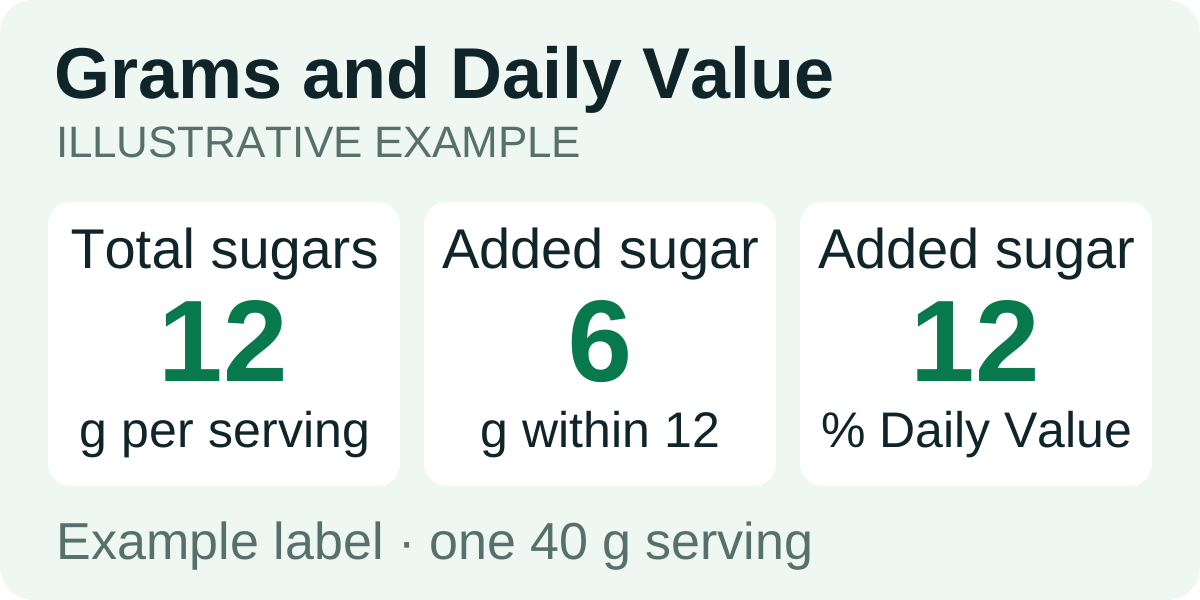
Grams tell you the amount in one label serving. Percent Daily Value compares that amount with the label’s daily reference for the nutrient. For added sugars the FDA reference is 50 g, so 6 g per serving corresponds to 12% DV. Total Sugars has no Daily Value on the US label.
Read across the row
Find the serving size first, then read the amount and percent on the same row. The percentage compares the nutrient with a daily reference. It does not describe what fraction of the food’s weight is sugar.
On this example label, a serving weighs 40 g. Its 6 g of added sugars is 12% of the 50 g reference. Those 6 g are already included in the 12 g Total Sugars. The blank percent next to Total Sugars is expected.
Scale the amounts to your portion
Suppose you ate 60 g. Divide 60 by the 40 g serving weight to get 1.5 servings. Multiply the grams by 1.5, then compare the added grams with the daily reference if you want the percentage.
| Example label detail | One serving, 40 g | Your portion, 60 g |
|---|---|---|
| Total Sugars | 12 g | 18 g |
| Added Sugars, included in Total Sugars | 6 g | 9 g |
| Added Sugars Daily Value | 12% | 18% |
When the label gives both grams and a rounded percentage, start from grams to scale the amount. The 50 g reference explains the percentage on the US panel. It does not set your personal intake.
Choose the number for your diary
If your diary asks for Total Sugars, use 18 g for this portion. If you are comparing added sugars across packages, first compare the same amount of each food or the amounts you actually plan to eat. Check the serving and column on each label before comparing.