 Nourmio
How to compare a US Nutrition Facts label with an EU label
Use the same portion weight to compare US and EU nutrition labels. See how to read calories, total sugars and missing added-sugar values.
Put both labels on the same weight before comparing them. A US label usually starts with one serving. An EU label gives values per 100 g or 100 mL and may show a portion too. The EU sugars row gives total sugars. You need a separate source to know how much sugar was added.
Pick the column that describes your food
The US Corn Flakes panel has a 42 g serving. Its dry cereal column lists 150 kcal and 4 g total sugars. The next column includes milk, so use the dry column when you weigh cereal on its own.
The French Corn Flakes panel lists 378 kcal and 8.0 g sugars per 100 g. It also has a 30 g column. Pick either basis and use its numbers and weight together. If the label prints energy in both kJ and kcal, use the kcal figure for your calorie entry.
Scale both panels to a 45 g bowl
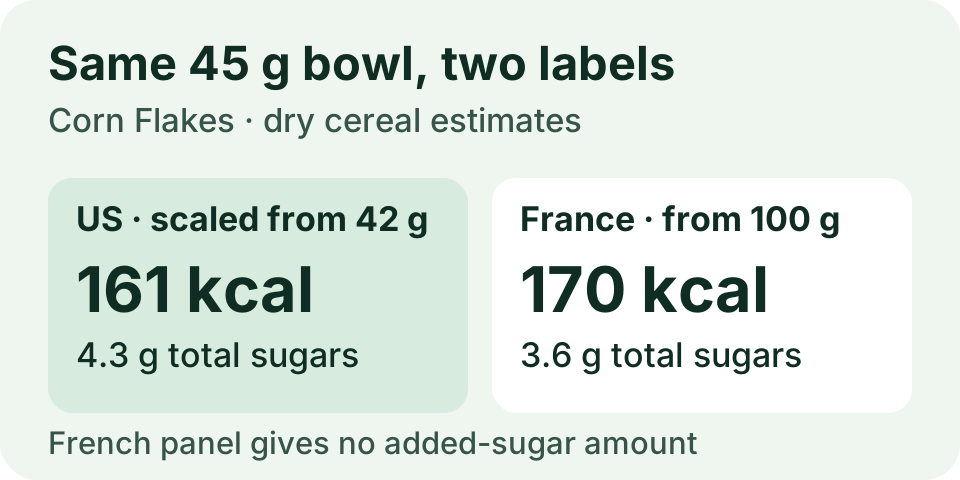
Suppose you weigh out 45 g of dry cereal. Divide 45 by the weight at the top of the label column. Use that fraction to scale the calories and sugars.
| Panel | Portion multiplier | Calories for 45 g | Total sugars for 45 g |
|---|---|---|---|
| US, per 42 g | 45 ÷ 42 | 150 × 45 ÷ 42 ≈ 161 kcal | 4 × 45 ÷ 42 ≈ 4.3 g |
| France, per 100 g | 45 ÷ 100 | 378 × 45 ÷ 100 ≈ 170 kcal | 8.0 × 45 ÷ 100 = 3.6 g |
The results are estimates from the two printed panels. Each panel describes its own product and market. For your portion, use the weight you measured and the label on your own box.
Read “dont sucres” as total sugars
The French phrase means “of which sugars.” It gives the sugars within the carbohydrate total. Sugar appears in the ingredient list, but the French panel gives no grams of added sugars. For the 45 g French example, enter 3.6 g total sugars and leave the added amount unknown.
On the US box, the label already includes the 4 g of added sugars in the 4 g of total sugars for 42 g. Use the total line once. See total and added sugars and the US Nutrition Facts guide for other label examples.
If you scan your box with Nourmio, compare the result with the market and portion printed on the package. You can enter the calories and total sugar yourself if the scan gives a different label.
Sources
- FDA: serving size on the Nutrition Facts label
- FDA: added sugars on the Nutrition Facts label
- European Commission: nutrition labelling
- Your Europe: nutrition declaration and energy units
- WK Kellogg US SmartLabel: Corn Flakes, GTIN 00038000991400
- Kellogg's France: original Corn Flakes
- Nourmio on the US App Store