 Nourmio
How to log cooking oil when some stays in the pan
Measure what leaves the bottle, separate that from what you know was eaten, and avoid treating all leftover pan liquid as pure oil.
Measure the oil you add before cooking. If you cannot measure how much of that oil stayed behind, record the amount added as an estimate and note the uncertainty. Do not subtract the weight of all pan liquid as though it were pure oil. For a shared dish, allocate the oil using the same portion basis as the rest of the food.
Measure the oil before it mixes with the food
Weigh the closed bottle before and after pouring, using the same cap and a clean, dry outside surface. The difference tells you how much left the bottle. It does not tell you how much reached your plate. Oil spilled on the counter or left on a utensil is part of that difference too.
Alternatively, tare a small container, weigh the oil in it, then transfer it. Note any amount visibly left in that container. Use grams with a per-gram nutrition value. A spoon measure needs a matching volume-based label value, not an assumption that a milliliter weighs one gram.
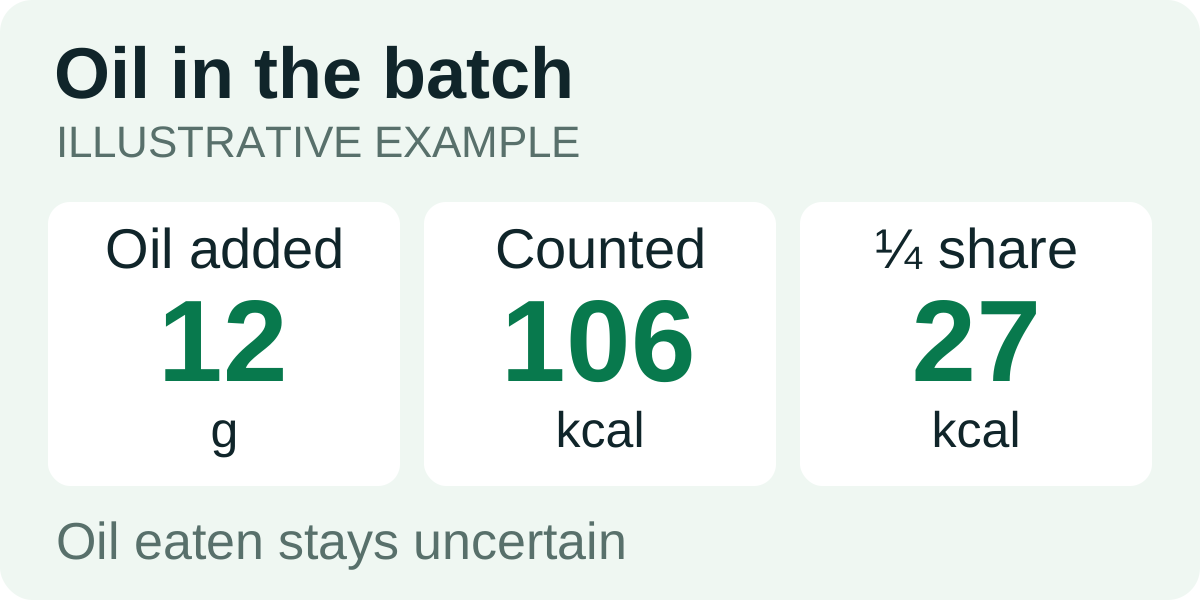
USDA’s olive oil reference, FDC 171413, lists 884 kcal per 100 g. In this worked example, assume all 12 g that left the bottle reached the pan. The weights are hypothetical.
| Record | Example | What it establishes |
|---|---|---|
| Closed bottle before pouring | 712 g | Starting bottle weight |
| Same bottle after pouring | 700 g | Difference: 12 g |
| Oil added, using the USDA reference | 12 × 884 ÷ 100 | 106.08 kcal, about 106 kcal |
| Four equal shares, assuming all oil is eaten | 106.08 ÷ 4 | 26.52 kcal, about 27 kcal of oil per share |
The last row concerns only the added oil. It is not the total calories in a portion of the meal.
Keep pan residue in the unknown column
After cooking, liquid in the pan can include water, juices, food particles and fat released by the ingredients, as well as the oil you added. A 20 g puddle is not evidence that 20 g of your original oil remains. Subtracting it as pure oil can remove calories that were never there in that form.
USDA’s cooking-yield research treats changes in fat and moisture separately. That work does not supply an absorption percentage for your own skillet. A before-and-after food weight alone cannot identify which material was lost.
If you count the whole 12 g in the example, note that you have assumed it was all eaten. That can overestimate the added oil eaten when some stays behind. It does not measure fat released by the food itself.
For deep-fried food with no usable recipe measurements, a suitable prepared-food entry may be a more workable estimate. Do not add the fryer’s entire oil supply to your serving. If the prepared-food entry already includes frying fat, adding the same oil again would count it twice.
Allocate the estimate to the food you actually eat
For a well-mixed finished dish, use your portion’s fraction of the finished weight. If you eat 200 g of an 800 g batch, your share is one quarter. Counting all the added oil gives your portion 26.52 kcal from that oil.
That allocation becomes weaker if one person gets a much oilier part of the pan. Record that limitation instead of adding more decimal places. When the components stay separate, calculate them separately rather than treating every gram of the plate as identical.
Include oil once in the ingredient list of the recipe nutrition calculator. Keep the oil amount and the finished batch weight with the recipe. For the full ingredient method, see counting a homemade meal.
Save the assumption with the entry
A useful note is “12 g oil added to the batch, all counted, some residue left.” It lets you distinguish a measured input from an uncertain amount eaten when you reuse the entry.
In Nourmio, check the portion’s calorie estimate before saving it in the diary. A photograph of the finished meal cannot supply the missing measurement of oil left in the pan.