 Nourmio
How to count sauces, dressings and toppings
Distinguish dressing dispensed from dressing eaten. Use a transparent leftover calculation, match label units and avoid counting included sauces twice.
Calculate sauce or topping calories from the amount you ate and a matching label or recipe. Some of the amount poured from a bottle can stay on the spoon or plate, so it isn't always the amount you ate.
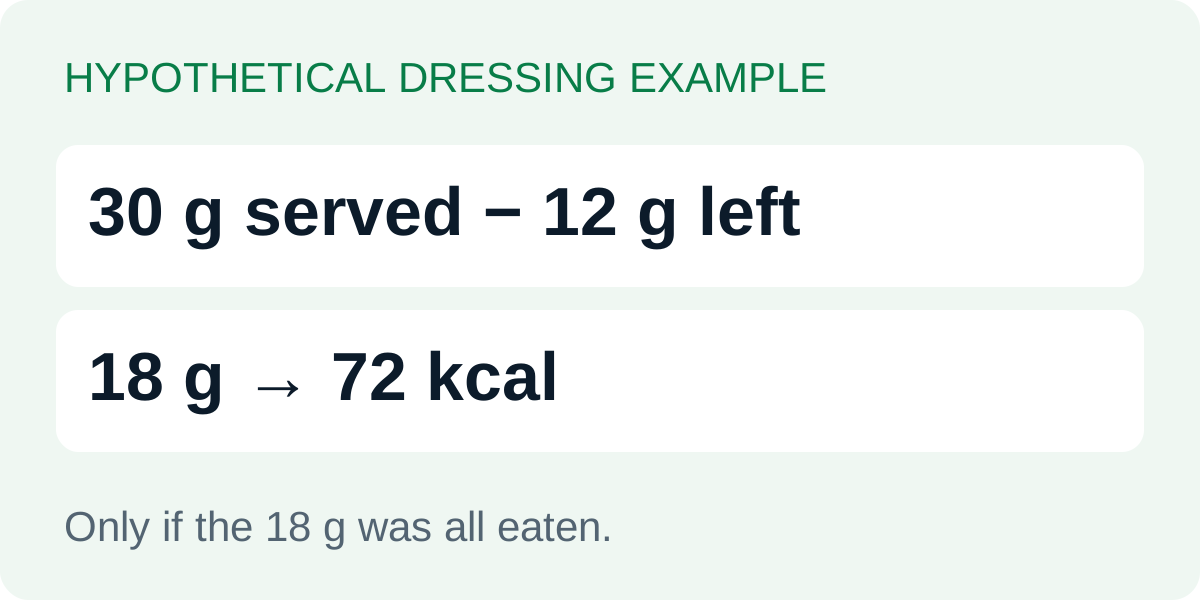
Programmatically drawn explanatory diagram. The examples and source limitations are explained below.
Check whether the meal already includes it
A meal entry or restaurant calorie value may already include sauce, cheese or dressing. Read what it describes before adding those ingredients again.
When the sauce comes separately, it can be easier to estimate your own amount. FDA’s menu guidance suggests asking for sauces and dressings on the side so you can choose how much to use. The size of the side cup still does not establish how much you ate.
Match the label’s unit to your measurement
Some labels use tablespoons or milliliters. Others state a gram weight. Use the same basis when scaling the nutrition.
Hidden Valley’s US Original Ranch page gives around 130 calories for a two-tablespoon serving. That does not establish a universal 30 g serving for ranch dressing. To use a gram measurement, find the matching gram basis on your product or a supported conversion.
A tablespoon of oil, dressing, seeds or grated cheese can have a different mass. Use a gram weight that matches the ingredient.
Work through a gram-based example
Suppose a dressing label lists 120 calories per 30 g. These are invented practice values, not Hidden Valley’s label. You serve 30 g into your own small dish and leave 12 g there.
If the remaining 12 g is still the same dressing, the calculated amount used is 30 − 12 = 18 g. If all of that used amount was eaten, the calorie calculation is 120 × 18 ÷ 30 = 72 calories.
| Stage in this example | Amount | What it establishes |
|---|---|---|
| Served into the dish | 30 g | Dressing available |
| Matching dressing remaining | 12 g | Dressing not used |
| Difference | 18 g | Dressing removed from the dish |
| Eaten, under the stated assumption | 18 g | Basis for 72 kcal |
The assumptions matter. If some dressing stayed on your plate, dripped onto a napkin or went to someone else, the difference is not all yours to log. Food or water mixed into the leftovers can also make their weight unsuitable for this subtraction.
This is a calculation model, not a weighing experiment conducted for the article.
Use a bottle difference for the right question
Weighing a bottle before and after pouring can establish the mass dispensed, provided you weigh the same bottle, cap and other parts both times. It does not show how much remained on the serving spoon or plate.
For a shared salad, the bottle difference describes dressing added to the shared dish. It does not tell you each person’s share. If you know the recipe and can reasonably divide a well-mixed batch, use the homemade-meal portion calculation. Keep uneven toppings separate when the average would mislead.
Treat cooking oil differently from an untouched dip
Oil added before cooking can remain in a pan, join a sauce or be discarded with cooking liquid. A pan’s final weight change can also include water and food.
Do not infer an exact amount of oil eaten from the total weight lost during cooking. If the amount retained is unknown, keep that limitation with the estimate rather than claiming a precise consumption measurement.
Keep the useful detail for next time
Save the product and serving basis along with the amount. “18 g of this dressing” is easier to check than a generic “one serving.”
Nourmio lets you review the portion and nutrition before saving. Include each sauce or topping once, using the most specific amount you can establish.