 Nourmio
Raw vs. cooked food weights: which entry should you use?
Match the weighed food state to its nutrition record. Compare two USDA rice entries and try the finished-batch portion calculation.
Match the food state you weighed to the food state in the nutrition record. Use a raw or dry weight with a raw or dry entry, and a cooked weight with a matching cooked entry. A cooked gram is not automatically equivalent to a raw gram.
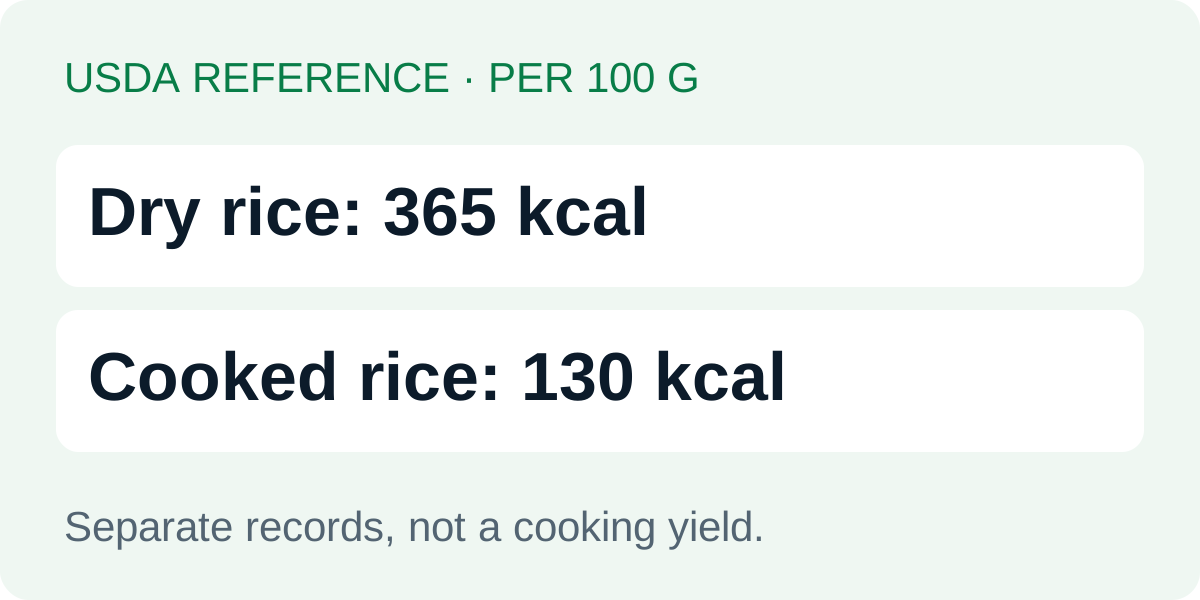
Programmatically drawn explanatory diagram. The examples and source limitations are explained below.
Read the full food description
Check the food, preparation and ingredients. “Rice, cooked” and “rice, dry” describe different amounts of water per 100 g. Fried rice also includes ingredients that plain boiled rice does not.
USDA SR Legacy provides separate records for raw enriched long-grain white rice, FDC 168877, and cooked enriched long-grain white rice, FDC 168878. The raw record lists 365 kcal per 100 g. The cooked record lists 130 kcal per 100 g.
These are reference records checked in USDA’s download on October 30, 2026. They are not measurements of the same rice batch before and after cooking.
See what a state mismatch does
Suppose you weigh a 150 g portion of cooked rice. Using the cooked reference gives 130 × 150 ÷ 100 = 195 calories.
Entering that cooked 150 g into the raw reference instead gives 365 × 150 ÷ 100 = 547.5 calories, or about 548. The wrong result came from pairing a cooked weight with a dry-food calorie value.
The ratio between these database values does not give your rice’s exact cooking yield. Water absorption, product and preparation can differ.
Choose the direct cooked-entry method
For food you already cooked without a recorded recipe, look for a cooked entry that matches the preparation. Check added fats, sauces, skin, bones and any parts you did not eat.
A generic cooked entry remains a reference estimate. It does not know exactly how much water your food retained. Keep separately added oil or sauce separate unless the selected entry already includes it.
Or calculate from your own batch
If you recorded the raw ingredients and know the nutrition retained in the finished dish, you can distribute the batch total using the finished weight. Our homemade-meals guide explains that method.
Consider an invented model: 100 g dry rice has 365 calories, the cooked batch weighs 300 g, and a portion weighs 150 g. Assume only water was added and none of the rice or its nutrient-bearing material was discarded.
The portion is half the finished batch. The calculation is 365 × 150 ÷ 300 = 182.5 calories, or about 183. Those numbers illustrate the method. They are not an observed cooking yield or proof that every 100 g of dry rice becomes 300 g cooked.
If fat or nutrient-bearing cooking liquid was discarded, the starting total may not all remain in the dish. Weight change alone does not identify what was lost.
Try the batch calculation
Use the portion calculator below. For the model above, enter 365 kcal for the batch, 300 g finished weight and 150 g eaten. Its default homemade-meal example is different, so replace all three fields.
The calculator distributes the calorie total you supply. It cannot determine cooking losses or choose a food record for you.
Keep the state with the saved entry
Include “raw,” “dry” or the relevant cooked preparation in your food description. Review that description when reusing a saved food.
Nourmio lets you check the amount and nutrition before saving. Keep the measured state and the reference state together, then apply the portion once.