 Nourmio
Recipe yield vs. servings: what number belongs in your diary?
Tell a recipe’s finished amount, serving count and portion weight apart before calculating what you actually ate.
Recipe yield is how much finished food a recipe makes. It may be written as a weight, volume, item count or number of servings. A serving count only divides that yield into planned portions. For your diary, use the amount you actually ate and a calorie total that describes the same batch.
Read the unit attached to yield
“Yield: 6” is incomplete unless you know what the six counts. It could mean six muffins, six containers or six planned servings. “Yield: 1,200 g” describes a finished amount by weight. “Yield: 6 cups” describes volume.
Recipe conventions differ. Look for the unit, portion instructions and nutrition basis before entering a number. The USDA Recipe Analysis Workbook separates servings per recipe from the serving amount. Its school-meal contribution calculations are not a calorie calculator, but the distinction between those fields is useful here.
Do not enter a recipe’s six servings into a field asking for finished grams. The numbers answer different questions.
Follow one card into a diary entry
This is a hypothetical card for a reasonably even mixture. The calories, sugar, finished weight and serving count are teaching inputs, not values for a named meal.
| Field | Example | Meaning |
|---|---|---|
| Whole-batch nutrition | 1,800 kcal and 24 g total sugar | Ingredients remaining in the entire dish |
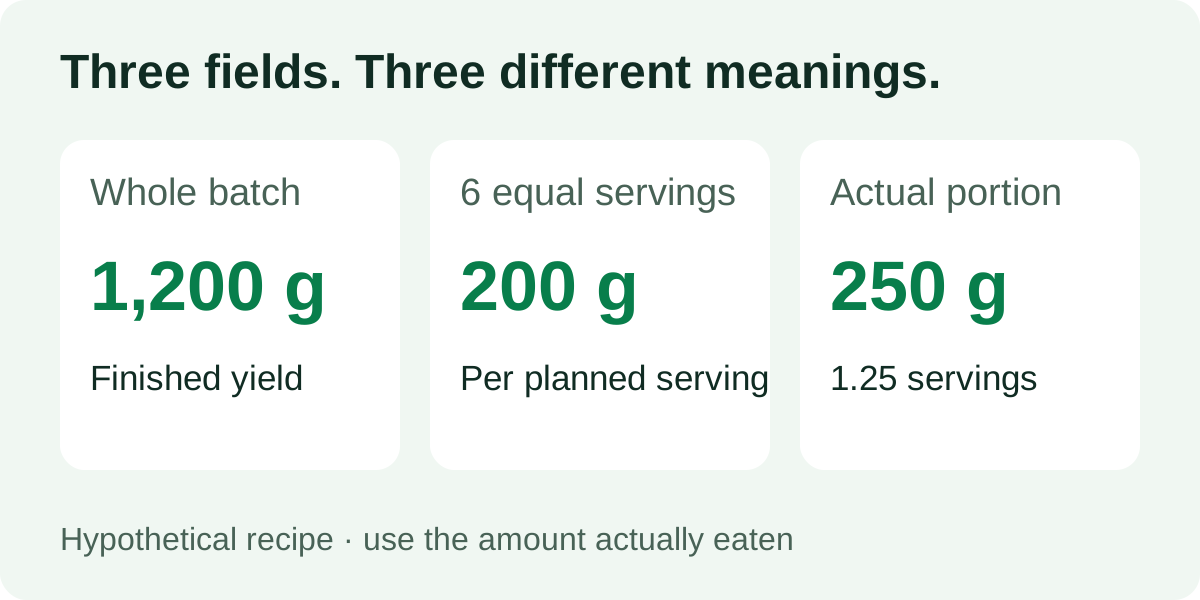
| Finished yield | 1,200 g | Food without its container |
| Planned servings | 6 | A way to divide the batch |
| One equal serving | 200 g | 1,200 ÷ 6 |
| Nutrition per equal serving | 300 kcal and 4 g sugar | Batch total divided by 6 |
| Portion actually eaten | 250 g | 1.25 planned servings |
| Nutrition in that portion | 375 kcal and 5 g sugar | 1,800 × 250 ÷ 1,200 and 24 × 250 ÷ 1,200 |
The 250 g portion is not one of the card’s 200 g servings. Calling both “one serving” would hide the difference. You can calculate from the batch fraction or multiply the per-serving values by 1.25. Both routes give the same result in this model.
Choose the field that matches what you know
- You know the batch weight and your portion weight: use the weight fraction, with both in the same unit.
- You have genuinely equal portions: divide the batch nutrition by their count.
- You have separate items of different sizes: do not assume each item has the same nutrition just because the recipe makes six.
- You know only a cup measure: keep it as volume. A cup is not a fixed number of grams for every food.
The recipe nutrition calculator has separate fields for finished weight, equal servings and portion weight. Supply only values you actually know. Its written example also works without JavaScript.
Recheck the yield when the batch changes
If you change the ingredients, recalculate the batch nutrition. If cooking changes the finished weight, use the new weight for that batch. A six-serving label does not force every version of a recipe to weigh the same amount.
For example, suppose the same modeled 1,800 kcal remain but only water is lost and the finished weight is now 900 g. A representative 250 g portion would be 500 kcal, not 375. That result depends on the stated assumption that calorie-containing ingredients were retained.
For uneven mixtures, weight alone may not represent the nutrient share. The homemade-meal guide explains that limit. Neither a recipe’s planned serving nor a package’s serving size is a personalized instruction about how much to eat.
Save the portion you ate
Keep “1,200 g finished batch, six planned 200 g servings” with the recipe, and “250 g eaten” with the diary entry. If you repeat the same meal, check the portion and preparation before reusing its numbers.
In Nourmio, save the checked calories and total sugar together. Keep unknown nutrient information separate from a reported zero.