 Nourmio
How to log a homemade smoothie you partly drank
Separate the blender batch, the amount poured and the amount left in your glass. A worked example avoids subtracting the same leftovers twice.
Total the ingredients in the blender, then measure the finished batch. Calculate the amount you drank from your filled glass minus the leftover drink, excluding the glass in both weights. Divide that amount by the finished batch weight, not by the amount first poured, to find your share of the whole recipe. This assumes the blend is reasonably uniform.
Keep three amounts separate
There is the smoothie you make, the smoothie you pour and the smoothie you drink. They are equal only if you pour and finish the whole batch. Logging “one smoothie” can hide a substantial difference between those amounts.
Start with each ingredient’s calories and total sugar, scaled to the amount you add. Use the actual package or a matching food reference. Include ingredients such as yogurt, fruit, juice and nut butter once. Water added to the blend changes the finished amount without adding calories. Do not count the blender jar as part of the food weight.
For this worked example, all weights and nutrition totals are hypothetical. They do not describe a tested recipe or a particular brand.
| Ingredient amount | Assumed calories for that amount | Assumed total sugar |
|---|---|---|
| 250 g yogurt ingredient | 150 kcal | 12 g |
| 200 g fruit ingredient | 100 kcal | 15 g |
| 100 g water | 0 kcal | 0 g |
| Complete example batch, 550 g | 250 kcal | 27 g |
Here, the finished batch is assumed to weigh 550 g with none discarded before measuring. In your kitchen, weigh the actual finished amount. Ingredient totals and that finished weight need to describe the same batch.
Subtract the drink left in your glass
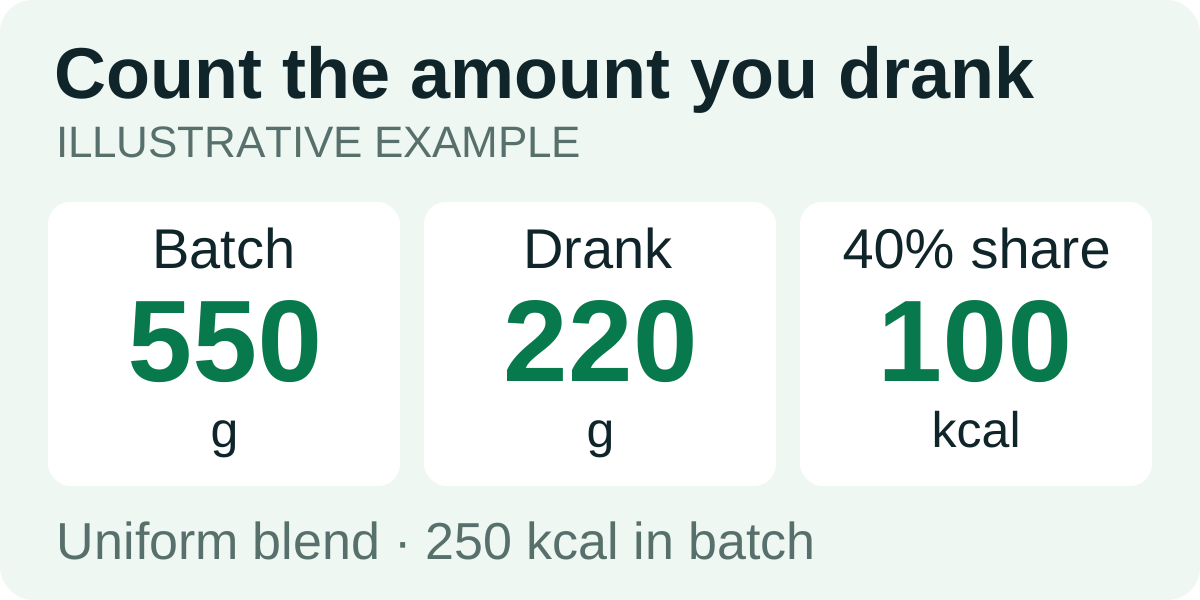
Suppose you pour 330 g from the 550 g batch. You stop with 110 g left in the glass. The amount drunk is 330 − 110 = 220 g.
You can get those amounts by taring the empty glass before filling it, then using the same empty-glass weight to remove the container from the later reading. A straw, spoon or ice added afterward can change the comparison. Keep the setup the same or account for the change.
The portion is 220 ÷ 550 = 40% of the entire batch. That gives 250 × 0.40 = 100 kcal and 27 × 0.40 = 10.8 g total sugar.
Using 220 ÷ 330 would instead say you drank two thirds of the amount poured. That fraction is also correct, but it must multiply the nutrition of the poured amount: 150 kcal and 16.2 g sugar. Two thirds of those values gives the same 100 kcal and 10.8 g. Do not multiply two thirds by the whole batch’s nutrition.
Account for leftovers once
In the example, 220 g remains in the blender and 110 g remains in the glass. Together with the 220 g drunk, that accounts for all 550 g.
| Where the smoothie went | Weight | Share of batch | Estimated calories |
|---|---|---|---|
| Drunk | 220 g | 40% | 100 kcal |
| Left in the glass | 110 g | 20% | 50 kcal |
| Left in the blender | 220 g | 40% | 100 kcal |
| Check | 550 g | 100% | 250 kcal |
The batch calculation already excludes the leftovers from your drunk portion. Do not subtract their calories again from the 100 kcal result.
This method assumes the drink you consume resembles the blend used for the total. Settled solids, a layer of nut butter or separate toppings make a single average less representative. Ice added after the first weighing adds mass, and melting can dilute what’s left. If you plan to weigh the glass twice, skip loose ice or blend it into the batch before weighing. Keep solid toppings separate when you can, and mark an uncertain fraction as an estimate.
Save the portion, with enough detail to repeat it
Use a name such as “yogurt-fruit smoothie, 220 g from 550 g batch.” Keep the ingredient references with the recipe. Changing the yogurt, adding juice or using a different fruit amount calls for a new total.
The recipe nutrition calculator can calculate the batch and a weighed share. Enter the amount drunk as the portion when you use the full finished batch as its denominator. Then save the checked calories and total sugar in Nourmio. No universal “one glass” value can replace those measurements.