 Nourmio
How to calculate meal-prep calories for unequal portions
Calculate separate components before you fill unequal containers. A worked three-box example checks that all food and calories are accounted for.
For an evenly mixed batch, multiply its estimated calories by each container's fraction of the finished weight. If the containers have different proportions of rice, meat, vegetables or sauce, allocate each component separately and add the results. Dividing by the number of boxes only works when the boxes contain equal shares.
Choose whether one batch average fits your boxes
An evenly mixed casserole can often use one estimated calorie value per gram. A box of rice, chicken and vegetables is different when you deliberately put more chicken in one box and more rice in another. The combined weight alone loses that distinction.
Weigh each cooked component without its pot or tray. Calculate its total from the ingredients you used, including its oil and sauce. Match raw ingredient values to raw weights and cooked values to cooked weights. Then weigh what goes into each container.
The example below uses hypothetical totals for the finished components. It assumes those calorie and sugar totals describe the food available to portion out. It does not estimate nutrients lost in discarded fat or cooking liquid. These numbers explain the arithmetic, not the nutrition of a particular rice, chicken or vegetable recipe.
| Finished component | Total weight | Estimated calories | Total sugar |
|---|---|---|---|
| Rice component | 600 g | 780 kcal | 4 g |
| Chicken component | 450 g | 720 kcal | 0 g |
| Vegetable component | 450 g | 180 kcal | 18 g |
| All components | 1,500 g | 1,680 kcal | 22 g |
Each total includes everything already mixed into that component. Do not log its cooking oil or sauce again as an extra topping.
Calculate one container component by component
Container A gets 200 g rice, 100 g chicken and 150 g vegetables. For the rice, its share is 200 ÷ 600, so the estimate is 780 × 200 ÷ 600 = 260 kcal. The chicken contributes 720 × 100 ÷ 450 = 160 kcal. The vegetables contribute 180 × 150 ÷ 450 = 60 kcal.
Add those three results: 480 kcal. Total sugar follows the same fractions: 4 × 200 ÷ 600 + 0 + 18 × 150 ÷ 450 = about 7.3 g.
Use unrounded values for the calculation, then round the finished entry. The zero in the chicken row is a stated input in this hypothetical example. An absent sugar value in a real database entry is not evidence of zero.
Check that the boxes account for all the food
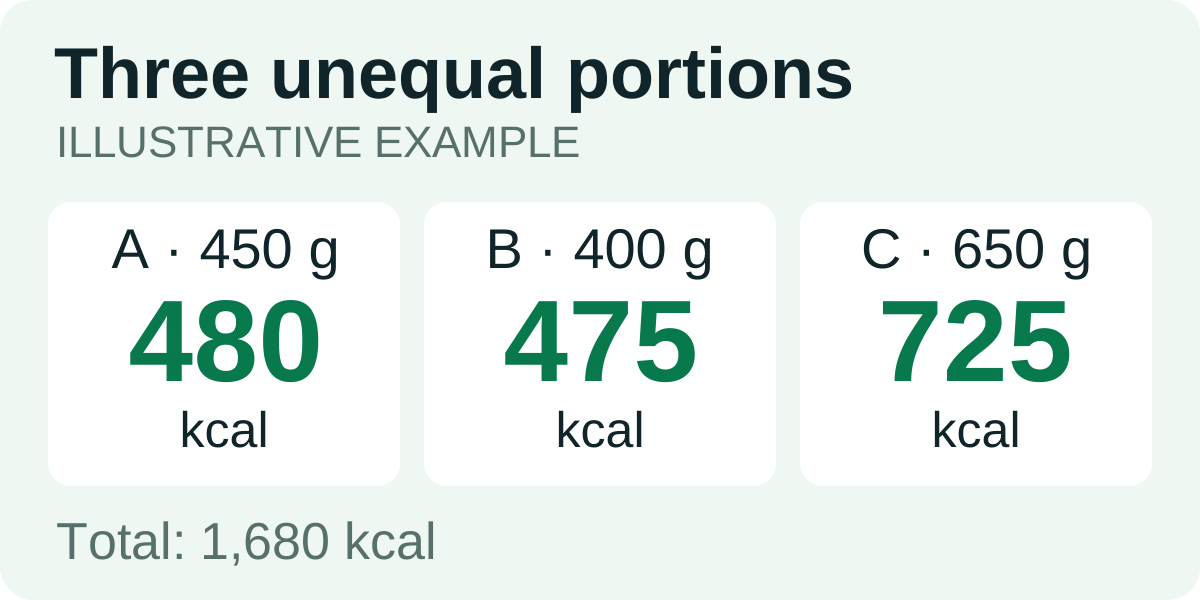
Here are three different containers using all the example food.
| Container | Rice | Chicken | Vegetables | Total weight | Estimated calories | Total sugar, rounded |
|---|---|---|---|---|---|---|
| A | 200 g | 100 g | 150 g | 450 g | 480 kcal | 7.3 g |
| B | 150 g | 150 g | 100 g | 400 g | 475 kcal | 5.0 g |
| C | 250 g | 200 g | 200 g | 650 g | 725 kcal | 9.7 g |
| Check | 600 g | 450 g | 450 g | 1,500 g | 1,680 kcal | 22.0 g |
Dividing 1,680 by three would assign 560 kcal to every box. That average does not describe any of these three boxes. Even dividing by total container weight assumes the same composition per gram, which these boxes do not have.
If your component weights do not add back to the finished totals, look for food left in the pan, a tasting portion or a missed container. Record it separately rather than forcing the last box to absorb the unexplained difference.
Keep labels useful when you open the fridge
Label the boxes A, B and C and save each estimate under its matching name. When you pull Box B from the fridge, its entry should still say 475 kcal and about 5 g total sugar.
For an individual component, the recipe nutrition calculator can calculate the share by weight. Repeat for the other components and add the results. The recipe yield guide explains why a serving count and finished weight are different inputs.
You can enter the checked total for the box in your Nourmio diary. Keep a note of the component amounts so a later change, such as an extra spoonful of sauce, can be added once.