 Nourmio
How to log fruit without treating total sugar as added sugar
Use exact USDA raw banana and strawberry records with edible portion weights. Follow the sugar calculation and handle missing added-sugar data correctly.
Log the total sugar in the edible fruit you ate. Sugar naturally present in plain raw fruit is included in total sugar. It is not added sugar simply because the fruit appears in a food diary.
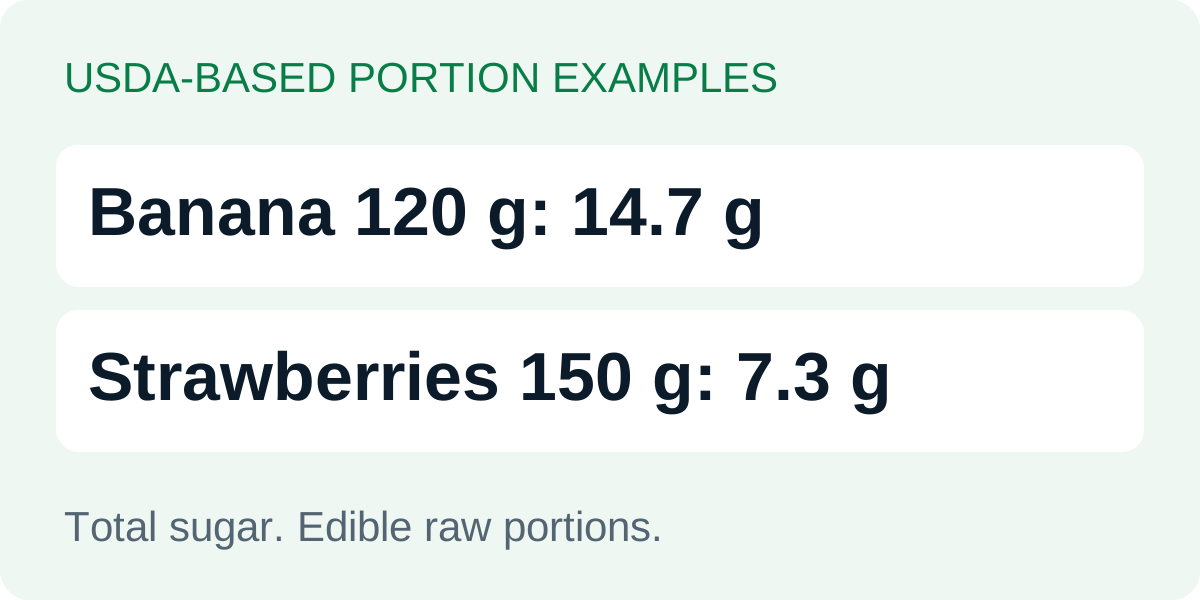
Programmatically drawn explanatory diagram. The examples and source limitations are explained below.
Match the fruit record to the food
Choose a record that identifies the fruit and its state. Raw strawberries, dried strawberries and strawberries in syrup do not describe the same food. Check the preparation and ingredients before using a number.
We use two specific USDA FoodData Central SR Legacy records here: Bananas, raw, FDC 173944, and Strawberries, raw, FDC 167762. The values are reference composition data, not measurements of your particular fruit.
We checked the original USDA download on October 30, 2026. It gives 12.23 g total sugar per 100 g raw banana and 4.89 g per 100 g raw strawberries. A missing added-sugar field in a database should not be interpreted as a measured zero.
Use the edible amount
For a banana, weigh the part you eat after removing the peel. For strawberries, exclude any tops or other parts you do not eat. The bowl’s weight should not be part of the food weight.
Suppose your edible banana portion is 120 g and your edible strawberries weigh 150 g. These are worked example portions, not a weighing experiment.
| Fruit reference | Sugar per 100 g | Example edible portion | Calculated total sugar |
|---|---|---|---|
| Raw banana, FDC 173944 | 12.23 g | 120 g | 14.676 g, about 14.7 g |
| Raw strawberries, FDC 167762 | 4.89 g | 150 g | 7.335 g, about 7.3 g |
Together, those example portions contain a calculated 22.011 g total sugar, or about 22.0 g. Calculate from the unrounded values before rounding the final result.
The reference values are averages for described foods. Fruit variety and composition vary, so the extra decimal places in the calculation do not make it a laboratory result for your bowl.
Keep total and added sugar separate
FDA includes sugars naturally present in fruit within total sugar. Plain raw fruit with no sweetener added contributes naturally occurring sugar, not added sugar. That conclusion follows from the ingredients and preparation, not from treating a missing database field as zero.
If your diary tracks total sugar, keep the fruit’s total in that field. Do not remove it to make the diary represent an added-sugar target.
A fruit cup with syrup, sweetened dried fruit or a smoothie with other ingredients needs its own check. The name “fruit” does not describe the entire recipe.
Add the rest of the bowl
If you add yogurt or honey, calculate those ingredients from their own labels. A photo cannot establish how many grams of a dissolved sweetener were used.
For example, a plain-yogurt label with zero added sugar can still contribute total sugar to the bowl. Our total versus added sugar guide explains why the two quantities should remain distinct.
Review a suggested fruit entry
Check the fruit name and the gram amount before saving an estimate. A suggested whole banana may describe a different edible weight from yours.
Nourmio lets you review the portion and nutrition details. Record the total sugar for the amount you confirm. If you are following an individual clinical nutrition plan, use the measurements and definitions agreed with your clinician rather than treating this arithmetic example as a personal target.