 Nourmio
How to compare sugar in plain and flavored yogurt
Compare two actual Stonyfield US labels at the same mass. Calculate a 150 g portion and keep total sugar separate from the included added sugar.
Compare plain and flavored yogurt at the same mass and read both Total Sugars and Includes Added Sugars. Plain yogurt can have total sugar without added sugar. The flavor name alone does not tell you the quantities.
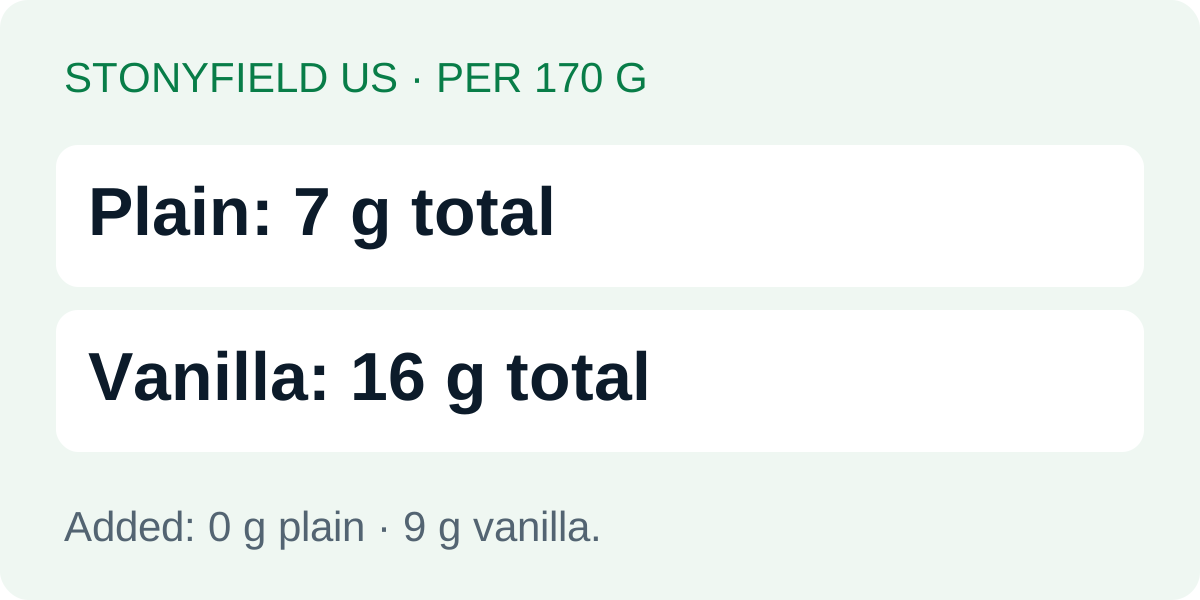
Programmatically drawn explanatory diagram. The examples and source limitations are explained below.
Start with the exact product and market
Check the brand, variety, container size and serving mass. A Greek yogurt, a regular yogurt and a plant-based yogurt are different products. A label from another country may use different fields and serving amounts.
For the comparison below, both sources are Stonyfield’s US 32 oz lowfat yogurt pages, checked on October 30, 2026. Each uses a 170 g serving. These are specific examples rather than averages for all plain or vanilla yogurts.
The manufacturer warns that its website can differ from products in stores. Use the label on your own container when it differs.
Read the two sugar lines together
| Stonyfield lowfat yogurt | Serving | Total sugar | Of that, added sugar |
|---|---|---|---|
| Plain, 32 oz multi-serve | 170 g | 7 g | 0 g |
| Vanilla, 32 oz multi-serve | 170 g | 16 g | 9 g |
For the plain example, zero added sugar does not erase the 7 g total. For the vanilla example, the 9 g added sugar is part of the 16 g total. The total is not 25 g.
Read each product’s added-sugar line directly. Subtracting the total sugar in a plain yogurt from a flavored yogurt is not a general way to discover added sugar. Their bases, ingredients and portions can differ.
Adjust the comparison to your bowl
Suppose you serve 150 g. Multiply each label value by 150 ÷ 170. This is a calculated portion, not a bowl measured for this article.
For plain yogurt, total sugar is 7 × 150 ÷ 170 = 6.18 g, or about 6.2 g. Added sugar remains zero in this label calculation.
For vanilla yogurt, total sugar is 16 × 150 ÷ 170 = 14.12 g, or about 14.1 g. Added sugar is 9 × 150 ÷ 170 = 7.94 g, or about 7.9 g.
If two products have different serving masses, you can first compare each at 100 g: divide its sugar grams by its serving grams, then multiply by 100. Use your actual bowl amount for the diary entry afterward.
Include what you add to the yogurt
A container label describes the yogurt, not everything in your breakfast bowl. Fruit, honey and granola may need separate entries or a recipe that includes them.
Check whether a packaged yogurt already includes its topping compartment in the stated nutrition. Adding a topping twice can be as misleading as leaving it out.
For raw fruit, use a matching food record and the edible amount. Do not automatically count the fruit’s sugar as added sugar. Honey added to the bowl is a different case under FDA’s definition.
Save the product you actually ate
Save the brand, variety and serving basis with the entry. Review them when you change containers or flavors. A saved plain-yogurt entry will not automatically describe a vanilla version.
Nourmio records total sugar rather than an added-sugar breakdown. In the 150 g vanilla example, the total-sugar amount is about 14.1 g. Our guide to total and added sugar includes practice with the two lines.