 Nourmio
How to compare sugar in sweetened and unsweetened dried fruit
Read the sugar rows on two dried mango labels. Compare sweetened and unsweetened portions at the same weight and calculate the sugar in your handful.
Read the ingredient list and both sugar rows. Dried fruit can contain sugar from the fruit even when no sweetener was added. Compare equal weights, since the Total Sugars numbers on two bags may describe different serving sizes.
Check what went into each bag
Costco’s sweetened Kirkland dried mango lists sugar as an ingredient. The organic dried mango in this comparison lists only mango. The organic bag still shows 24 g Total Sugars per 40 g serving, with 0 g Added Sugars.
The other bag uses a 42 g serving. It lists 27 g total, including 8 g added. To see what the figures mean for the same handful, put both on a 30 g basis.
Compare a 30 g portion from each bag
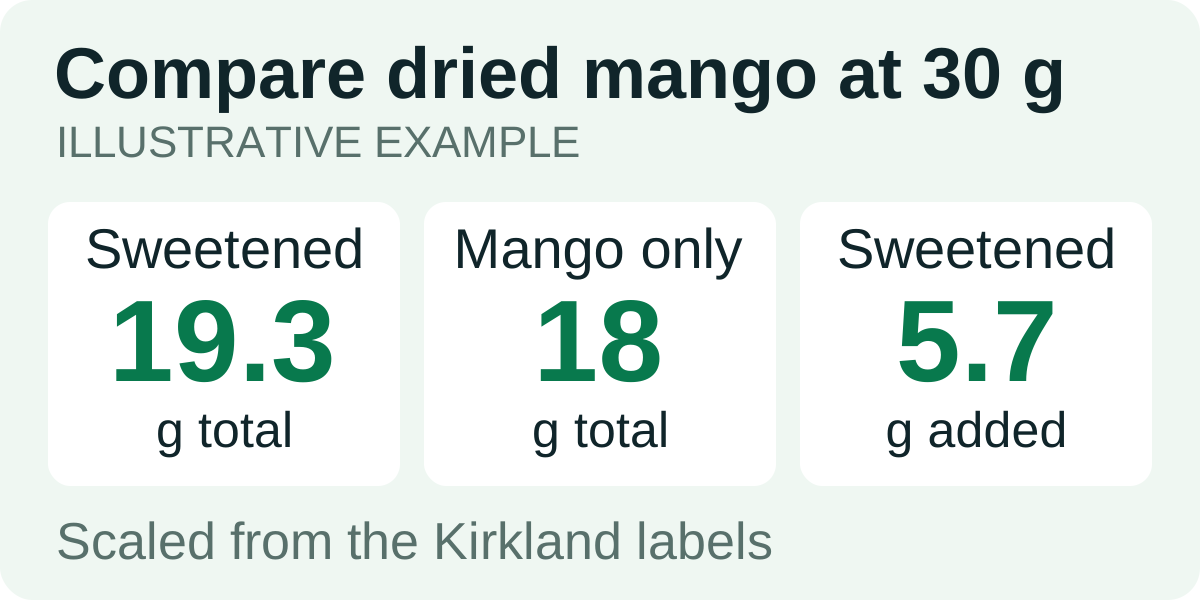
| Per 30 g | Total sugars | Added sugars |
|---|---|---|
| Kirkland Sweetened | 19.3 g | 5.7 g |
| Kirkland Organic | 18 g | 0 g |
For the sweetened bag, calculate 27 × 30 ÷ 42 for total sugars and 8 × 30 ÷ 42 for added sugars. For the mango-only bag, calculate 24 × 30 ÷ 40 for the total. Round after scaling.
The difference in total sugar is about 1.3 g for these two 30 g portions. The difference in added sugar is about 5.7 g. Both results use the stated label values, which are already rounded.
Use the package that matches your snack
Weigh the dried fruit you actually took from the bag. Scale the Total Sugars number on that bag to your portion. If the fruit went into a trail mix, account for it as an ingredient or use the matching packaged mix entry.
A fresh-mango entry describes a different food state. For a fresh piece of fruit, use the matching fresh-fruit portion.