 Nourmio
How to choose the right food database entry
Compare two USDA yogurt entries with the package label. Check the product, preparation, and serving size before you log calories or sugar.
For packaged food, match the brand, exact product, and serving weight to the label on your package. For food without a label, choose an entry that matches how it was prepared and what you weighed. Two results can give almost the same calories even if only one lists total sugar.
Match the package before comparing the numbers
Say you’re holding a 150 g cup of Chobani plain nonfat Greek yogurt. One USDA record names the brand and gives 54 kcal per 100 g. A second record specifies the 5.3 oz cup and includes the package code. The unit UPC is 894700010014 in Chobani’s specification and appears as 00894700010014 with two leading zeros in the branded record.
Both records look plausible by name. The UPC and serving weight tie the branded entry to this particular US cup. The current online grocery panel also lists 80 kcal and 5 g total sugar for one 150 g container. If the label on your cup differs, use the one you’re holding.
Put both records on the same weight
The historical record is labeled SR Legacy and dated April 2019 in FoodData Central. The branded entry is dated April 2026. The date describes the database record. Check the package details even when a record is newer.
| FoodData Central record | Calories per 150 g | Total sugar per 150 g |
|---|---|---|
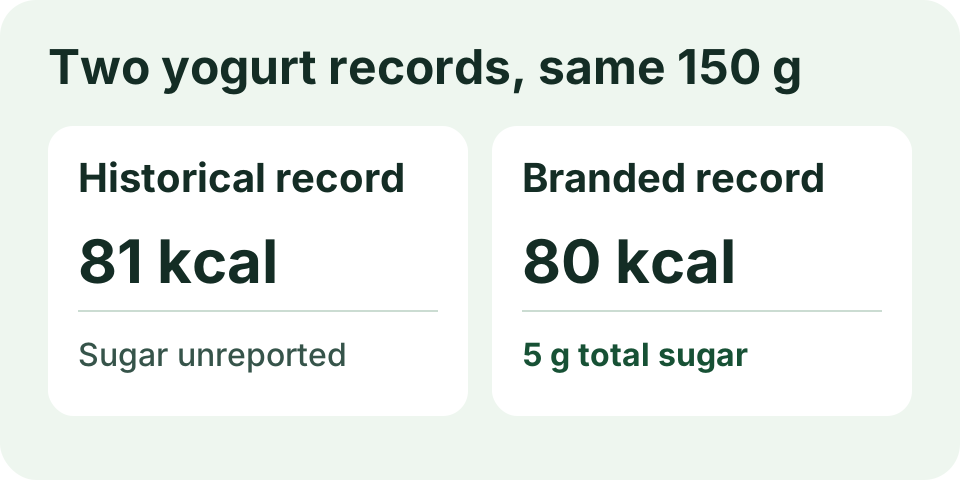
| 171312, historical | 54 × 150 ÷ 100 = 81 kcal | Not reported |
| 2757147, branded | 80 kcal per container | 5 g |
The historical estimate is only 1 kcal higher. The missing sugar field still leaves the amount unknown for that record. On the cup’s panel, 5 g is total sugar. The added-sugars line is separate. See how to read those lines on a US label.
Log the part you ate
If you eat 75 g from this cup, you ate half the labeled serving. That gives about 40 kcal and 2.5 g total sugar using the package values. Weigh the yogurt without the cup or lid. Use the same portion fraction for each nutrient that has a value.
For food without a package label, choose a general entry that describes the edible food in the same state you weighed it. A record for a cooked food can have a different amount per 100 g than its raw counterpart. See which entry to use for raw or cooked weights.
If you scan the package in Nourmio, check the result against the label before saving. When the flavor, weight, or values differ, use the package numbers. For a field that asks for nutrition per 100 g, divide each printed amount by 150 and multiply by 100. Enter the weight you actually ate as the portion.