 Nourmio
No added sugar, sugar-free and unsweetened: compare the labels
Read the front claim, then check total sugar, added sugar and serving size using three documented US product examples.
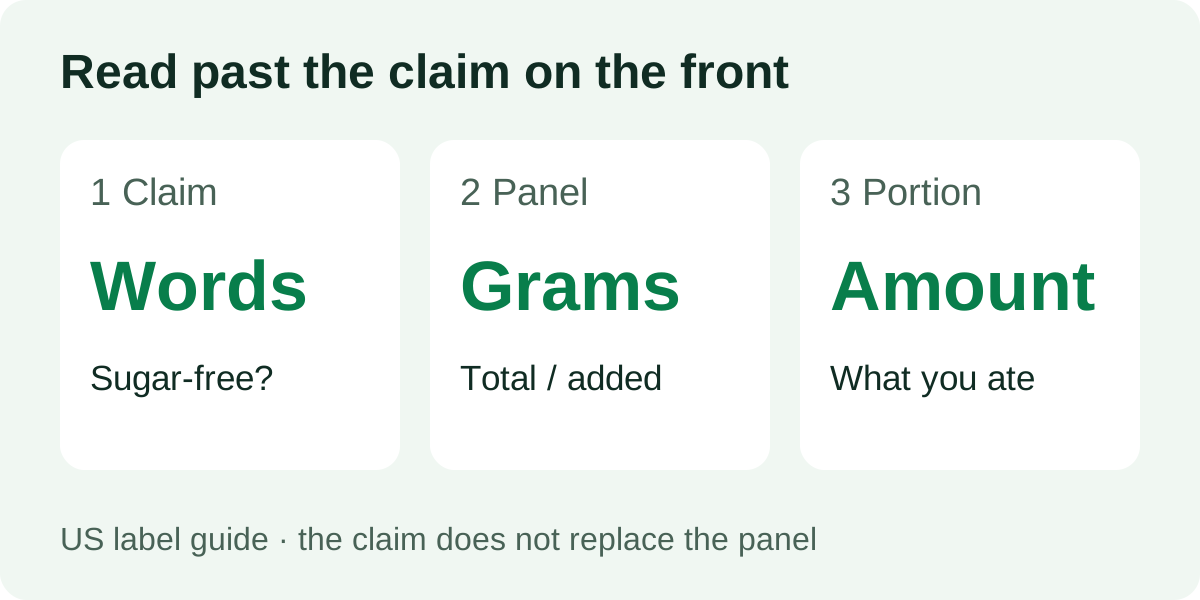
For US food labels, sugar-free and no added sugar make different claims. Sugar-free has a defined low-sugar threshold. No added sugar concerns what happens during processing and can still leave naturally occurring sugar in the food. Unsweetened does not give you a total-sugar number. Check the Nutrition Facts panel and ingredients.
What each phrase lets you conclude
Under the US rule for sugar claims, sugar-free generally requires less than 0.5 g sugar per reference amount customarily consumed and per labeled serving. Meal and main-dish products use the rule’s serving basis. There are additional ingredient and labeling conditions. The phrase does not by itself mean calorie-free.
No added sugar has processing and ingredient conditions. It does not mean that the ingredients contain no sugar of their own. The rule also addresses calorie statements that must accompany qualifying products.
With unsweetened, check the ingredients and sugar lines rather than assuming a numeric threshold. The same rule distinguishes factual unsweetened statements for foods with substantial inherent sugar from sugar-free claims.
This guide helps read a package. It does not determine whether a manufacturer has met every labeling requirement.
Read three documented US examples
These are separate products, not substitutes ranked by nutrition. Different foods and serving units should not be compared as though their portions were equal.
| Product and source | Claim | Source serving | Calories | Total sugar | Added sugar |
|---|---|---|---|---|---|
| Smucker’s Sugar Free Seedless Strawberry Jam | Sugar-free | 1 tbsp (17 g) | 10 kcal | 0 g | 0 g |
| Mott’s No Sugar Added Applesauce | No added sugar | 123 g | 50 kcal | 12 g | 0 g |
| Silk Unsweet Almondmilk | Unsweet | 1 cup (240 mL) | 30 kcal | 0 g | 0 g |
The pages were checked November 6, 2026. The Mott’s declaration is dated January 24, 2025 and is hosted by a distributor. It describes a 123 g serving. Do not transfer its values to a different cup or pouch. Use the package you have if its serving or formulation differs.
The applesauce example is the useful distinction: 0 g added sugar and 12 g total sugar can both be correct. Total sugar already includes added sugar when it is present. Do not add the two lines together.
Smucker’s also lists sucralose in the ingredients. Sugar-free does not necessarily mean unsweetened or free of sweeteners. Its 10 kcal serving illustrates why the sugar claim cannot replace the calorie line.
Scale the panel to the amount you eat
For a hypothetical 61.5 g portion of the applesauce described in that sheet, the multiplier is 61.5 ÷ 123 = 0.5. The label-based calculation gives 25 kcal and 6 g total sugar. Added sugar remains 0 g as reported by that source. This is arithmetic from rounded label values, not a chemical measurement of a serving.
A label’s reported zero is also not a guarantee that any-sized portion contains exactly zero sugar. Use the stated serving and keep rounding in mind.
If you want practice with the two sugar lines, try the total and added sugar label exercise. For the rest of the panel, see how to read a US Nutrition Facts label.
Save the amount, not the front-of-pack claim
Record the product, portion and total-sugar grams from the panel. A note saying only “no added sugar” cannot tell you how much total sugar you ate.
Nourmio tracks calories and total sugar together. It does not separate added sugar from naturally occurring sugar, so keep that distinction with the source label.