 Nourmio
Why no-added-sugar apple juice still contains sugar
See why apple juice from concentrate can show zero added sugar. Use two US label examples to calculate total sugars for the amount you drink.
Apple juice contains sugar from apples. A US bottle can list 0 g Added Sugars and still show a nonzero Total Sugars number. Juice concentrate can be part of the juice base. Read the sugar rows, then use the serving size to work out what you drank.
Read “from concentrate” with the sugar rows
Both products below list water and apple juice concentrate in the ingredient information. Under US rules, concentrate used toward the declared juice percentage is one of the cases excluded from Added Sugars. The ingredient name alone does not tell you what the Added Sugars row will say. Check the panel for that bottle.
Kroger’s no-sugar-added bottle lists 28 g sugars and 0 g added. A Mott’s manufacturer sheet dated April 2020 lists 34 g total and 0 g added per 10 fl oz. Use that older sheet to follow the math. Check the panel on your bottle for its actual serving size and sugar values.
Put the bottles on the same volume basis
| Total sugars | Per bottle | Per 8 fl oz |
|---|---|---|
| Kroger, 8 fl oz | 28 g | 28 g |
| Mott’s, 10 fl oz (2020 sheet) | 34 g | 27.2 g |
For Mott’s, 34 × 8 ÷ 10 = 27.2 g. The larger bottle has more sugar as sold, while the scaled amounts are close at the same volume. The 0 g added figure belongs to both labels.
Log the amount you drank
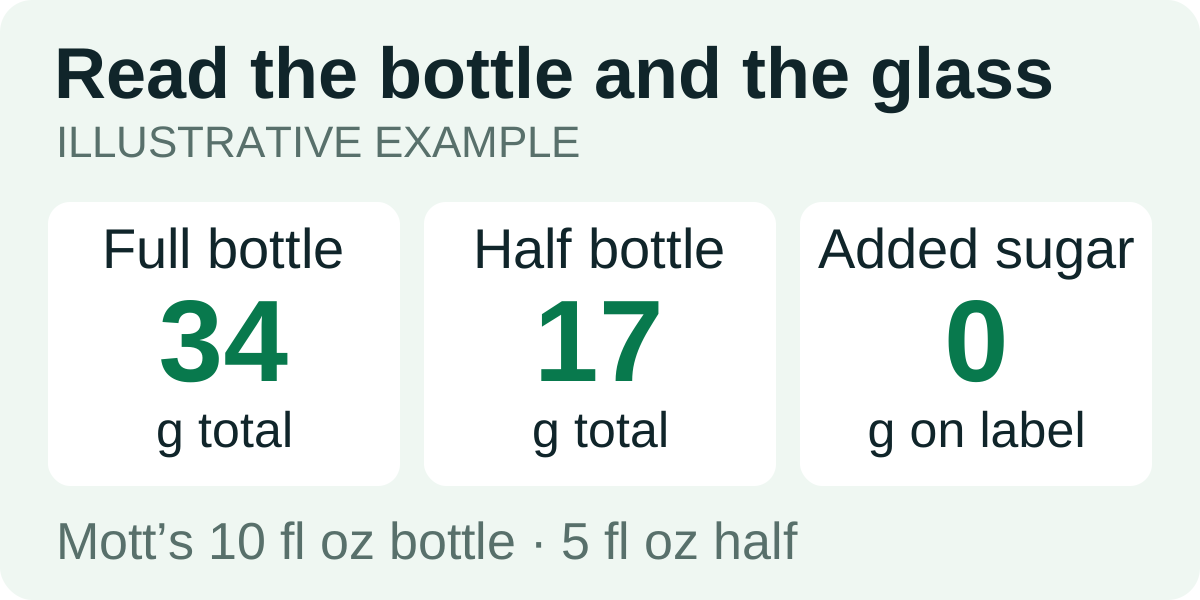
If you drank 5 fl oz from the 10 fl oz Mott’s bottle, use 34 × 5 ÷ 10 = 17 g total sugars. If you finished it, use the 34 g total per bottle. Check the package if you have another bottle size, and keep both volumes in the same unit when you calculate.
For a different beverage, use the same equal-volume comparison, starting with the Total Sugars line on the relevant label.