 Nourmio
How to compare sugar in drinks of different sizes
Compare sugar at an equal volume, then calculate the amount you drank. Work through two named US Coca-Cola labels without mixing total and added sugar.
Compare drink sugar at the same volume, then calculate the amount you actually drank. A smaller container can contain less sugar overall while having the same sugar concentration. Keep total sugar separate from the added-sugar line.
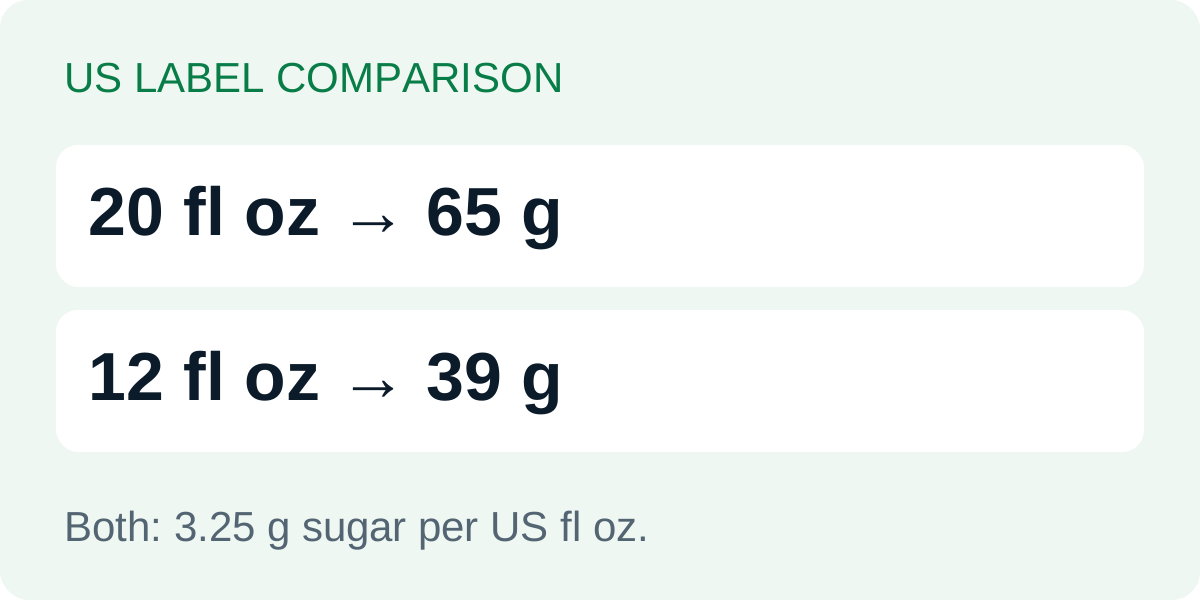
Programmatically drawn explanatory diagram. The examples and source limitations are explained below.
Answer two different questions
For a shopping comparison, use an equal volume of each drink. For your diary, use the volume you drank.
Read the serving size and check whether the sugar amount describes a serving or the entire container. Some drinks have one serving per bottle. Others provide several servings or two label columns.
Compare two US manufacturer examples
Coca-Cola’s US page lists 65 g total sugar and 65 g added sugar for a 20 US fl oz bottle of Original. The same page lists 39 g total and added sugar for a 12 US fl oz can of Caffeine Free. These are two named variants, not an assertion that their ingredients are identical.
The manufacturer values were checked on October 30, 2026. Your own current package takes priority if it differs.
| Comparison | Original, 20 fl oz bottle | Caffeine Free, 12 fl oz can |
|---|---|---|
| Total sugar in the stated container | 65 g | 39 g |
| Total sugar per US fl oz | 3.25 g | 3.25 g |
| Calculated sugar in 12 US fl oz | 39 g | 39 g |
The larger bottle contains 26 g more sugar overall in this comparison. Its listed sugar per fluid ounce is the same. Equal sugar concentration does not establish equal caffeine or other ingredients.
Calculate what you drank
If you drink half of the 20 fl oz Original bottle, the volume is 10 fl oz and the calculation is 65 × 10 ÷ 20 = 32.5 g total sugar.
If you finish the bottle, use its 65 g total. Do not enter 65 g and then add the 65 g added-sugar line. Added sugar is included in the total.
For your own drink, calculate:
Sugar in your amount = label sugar × your drink volume ÷ label volume.
Use the same volume unit in the two volume positions. If the label uses milliliters, use milliliters for your amount too. Fluid ounces describe volume. A kitchen scale’s ounces describe mass, so do not substitute one for the other.
Keep milk and juice comparisons clear
FDA’s definition of total sugar includes naturally occurring sugar as well as added sugar. A drink can therefore have total sugar even when its added-sugar line is zero.
That difference does not change the total you record. It also means that a total-sugar comparison alone does not answer an added-sugar question. Read the relevant line for each drink.
The examples here compare label quantities. They do not set a personal sugar target or rank every beverage’s nutritional value.
Record the drink once
Check whether your meal entry already includes a drink. If it does, do not add the same drink again as an extra.
For homemade coffee with milk and syrup, calculate the ingredients separately unless you use a matching combined recipe. For a packaged drink, its current label is the direct starting reference.
Nourmio tracks total sugar in the amount you confirm. Use the label guide if the “Includes” line is unclear, then save the drink and its portion in your diary.