 Nourmio
How to compare sugar in milk and plant-based drinks
Compare total and added sugars in whole milk, original soy milk and unsweetened soy milk at the same volume. Calculate the sugar in a smaller pour.
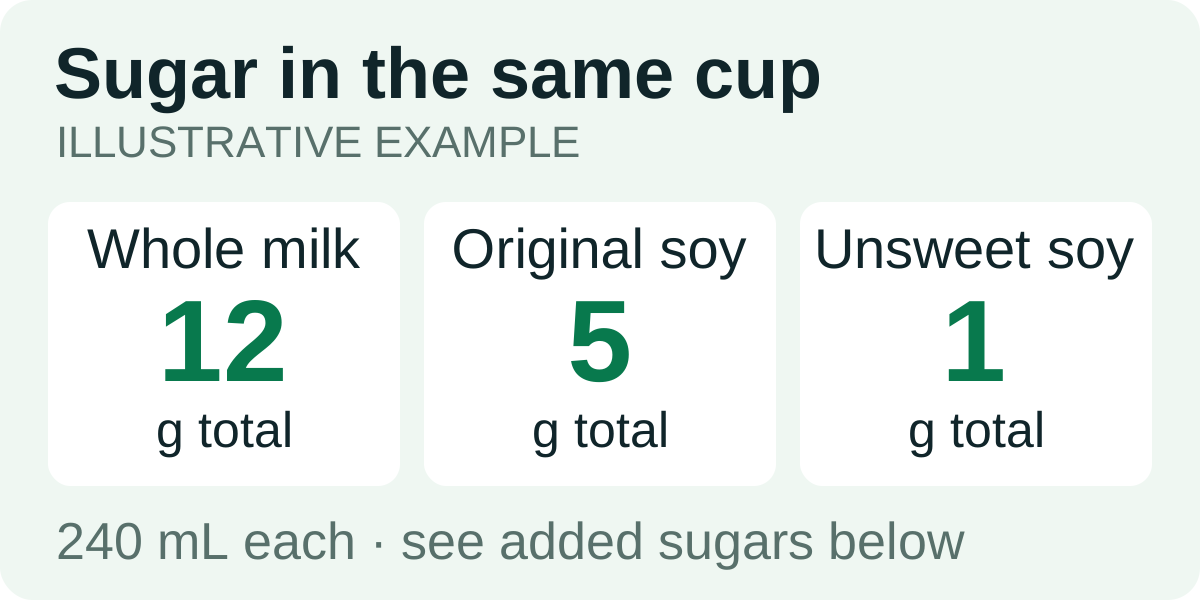
Compare the same volume and read both sugar rows. In the three US labels below, a cup of whole milk has 12 g of total sugars and zero added, while a cup of original soy milk has 5 g total, including 4 g added. Which carton has more depends on the row you are comparing.
Decide which sugar row you want to compare
The sugar naturally present in milk appears under Total Sugars. A sweetened plant drink can show fewer grams of total sugars than the milk and still show more added sugars. The word “includes” on the Added Sugars row tells you those grams are already part of the total.
Use the back panel on the carton you picked. “Original” and “unsweet” identify variants, and the two can have different values even within the same brand.
Read three labels at one cup each
These US products all use 1 cup (240 mL), so their printed sugar amounts are directly comparable.
| Product | Total sugars | Added sugars |
|---|---|---|
| Horizon Organic Whole Milk | 12 g | 0 g |
| Silk Original Soymilk | 5 g | 4 g |
| Silk Unsweet Soymilk | 1 g | 0 g |
In this group, whole milk is highest in total sugars, while Original Soymilk is highest in added sugars. Those two comparisons answer different shopping questions. The table compares the three named products and leaves other nutrients out of the comparison.
Scale the row to your pour
If you poured 120 mL, use half of each 240 mL amount. That gives 6 g total sugars for the whole milk, 2.5 g for Original Soymilk, and 0.5 g for Unsweet Soymilk. The same 120 mL of Original Soymilk has 2 g added, already included in the 2.5 g total.
Use the total for a diary entry that asks for total sugar. For a latte, use the volume of milk or plant drink that went in and count any syrup separately.