 Nourmio
How many calories do I need per day?
Understand daily calorie estimates, check a worked TDEE example, and separate energy expenditure from an intake plan and your food diary.
There is no single daily calorie number for everyone. Your estimated energy needs depend on your age, height, weight and activity. A TDEE calculator estimates daily energy expenditure. It does not establish the intake that is suitable for your health or goals.
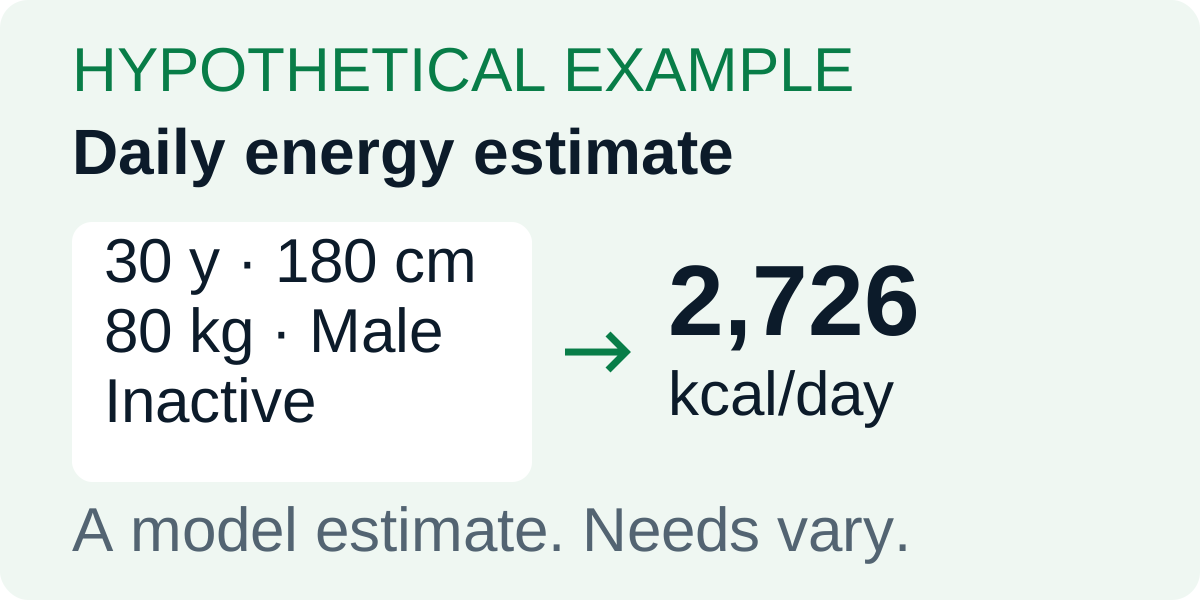
Calculated example using the DRI 2023 equation. These inputs do not describe a measured person. The result is not an intake recommendation.
The 2,000-calorie label is a general reference
A food label may mention a 2,000-calorie daily diet. The FDA describes that number as a general guide for nutrition advice. It does not calculate your own needs. Check whether the calorie column describes a serving, a package or a unit, then match it to the amount you eat.
Daily expenditure and food intake describe different quantities:
| Number | What it describes | What it cannot decide |
|---|---|---|
| TDEE estimate | Energy expenditure over a day | A personally suitable eating plan |
| Planned intake | An amount chosen for a plan | What you actually ate |
| Food diary total | Calories recorded from food and portions | Your measured daily expenditure |
Try an adult daily-needs estimate
TDEE means total daily energy expenditure. The tool below uses the adult equations in the 2023 Dietary Reference Intakes for Energy. For weight-stable adults, that reference relates daily expenditure to estimated energy requirements.
This equation set starts at age 19. The tool does not apply it during pregnancy or breastfeeding. It cannot assess your medical history or decide whether calorie tracking or a particular intake suits your needs. A health professional who knows your circumstances can help with that decision.
Enter age, height and weight with the correct units. Select the reference equation and activity category. Choose Use example to fill the form with hypothetical inputs. Clear removes them. The same tool is available on the daily calorie needs calculator page.
Follow the example before using the result
The example uses the male equation, age 30, height 180 cm, weight 80 kg and inactive category. Its arithmetic is:
753.07 − 10.83 × 30 + 6.50 × 180 + 14.10 × 80 = 2,726.17 kcal/day.
The screen rounds the result to about 2,726 kcal/day. Decimal places describe the calculation’s arithmetic. They do not show how closely it matches a person’s needs.
Activity refers to the whole daily routine, including travel, household tasks, work and leisure. Read the linked 2023 activity definitions rather than choosing from workout frequency alone. This model uses a different equation for each category. Adding another activity multiplier to the answer would count the category again.
Check the method when calculators disagree
Before comparing two results, check whether the tools use the same inputs and equations. Confirm that both results describe daily expenditure. A result after a chosen reduction also differs from an unchanged maintenance estimate.
Confirm the age, height and weight units, the selected activity definition, and whether an adjustment has already been applied. Comparing a rounded number with an unrounded one can explain small differences. Matching the method still does not make the number an individual measurement.
The NIDDK Body Weight Planner includes a goal weight and a time period. This article’s calculator does not forecast a future weight or choose a goal date.
Keep food records separate from the estimate
A meal entry needs the food and the amount eaten. A daily-needs estimate cannot supply those details. The homemade-meals guide explains how to work from ingredients to your portion. For meals you repeat, check the portion and changes before reusing an entry.
Nourmio is our food diary for calories and total sugar. You can keep meal records together while checking the food and portion information. This calculator estimates expenditure and does not transfer a target or its inputs to the app. The Store link opens Nourmio for iPhone.