 Nourmio
How a calorie deficit calculator works
Follow a calorie deficit calculation, compare kcal with percent, and understand the maintenance estimate, output limits and food diary connection.
A calorie deficit occurs when energy intake is lower than energy expenditure. A calorie deficit calculator subtracts a reduction you choose from an estimated maintenance baseline. The result is an arithmetic intake scenario, not a prescription or a prediction of how fast your weight will change.
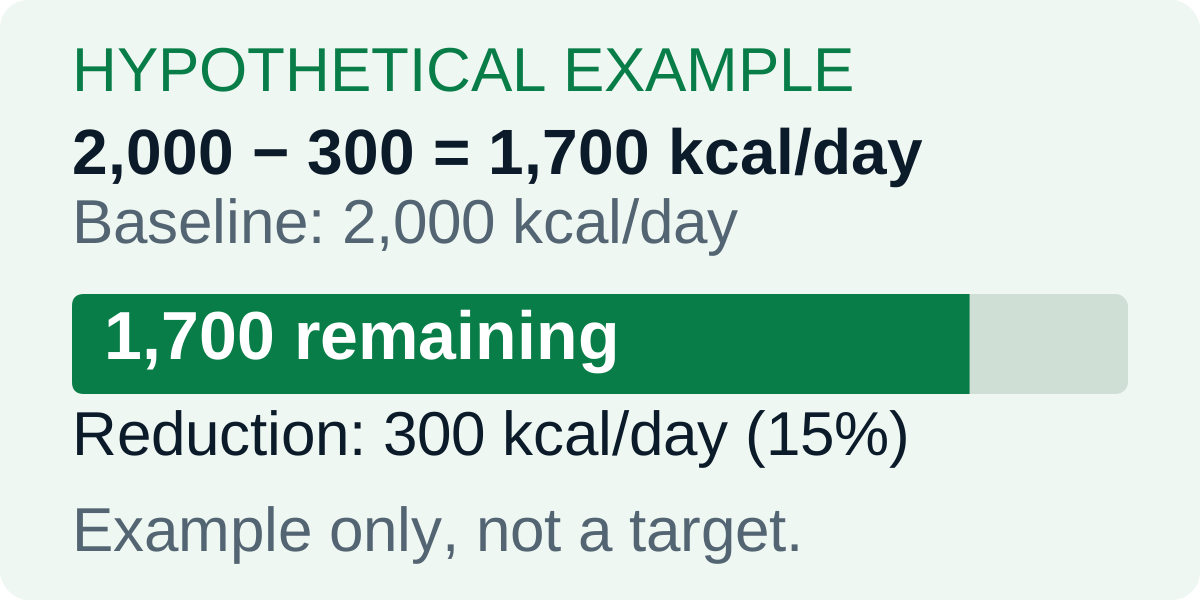
A hypothetical subtraction example. The numbers do not describe a measured person, a recommended reduction or a forecast of weight loss.
Start with the maintenance estimate
Maintenance describes the energy intake associated with keeping body weight stable. A calculator estimates a starting number. In the adult DRI 2023 reference, estimated expenditure represents estimated energy requirements for a weight-stable adult.
The form offers two starting points. Estimate with DRI 2023 uses the selected age, height, weight, reference equation and activity category. Enter an estimate I already have accepts a number from another source. Entering a number does not confirm that it is correct or suitable.
Both modes are limited here to adults 19 and over, outside pregnancy or breastfeeding. A typed number does not remove that limit. This tool does not assess your health circumstances or select an intake plan. A health professional who knows your situation can address questions about a personal plan.
Compare a scenario in the calculator
Choose the source of the maintenance estimate, then enter a reduction in kcal/day or percent. Enter zero to see a maintenance scenario. The tool does not choose a reduction when you first open it. Use example fills the form with hypothetical inputs. Changing reduction units clears the amount so the same number isn’t reused with a different meaning.
The separate calorie deficit scenario calculator uses the same form. No inputs or results are transferred to Nourmio.
The same reduction can be written in two units
Suppose a maintenance estimate is 2,000 kcal/day and the selected reduction is 300 kcal/day. The calculation gives 2,000 − 300 = 1,700 kcal/day. As a percentage, 300 ÷ 2,000 × 100 = 15%.
The following rows are made-up arithmetic scenarios, not recommended reductions or intake targets. Their common baseline makes the difference between an amount and a percentage visible.
| Selected reduction | Share of the 2,000-kcal baseline | Arithmetic remainder |
|---|---|---|
| 0 kcal/day | 0% | 2,000 kcal/day |
| 200 kcal/day | 10% | 1,800 kcal/day |
| 300 kcal/day | 15% | 1,700 kcal/day |
| 400 kcal/day | 20% | 1,600 kcal/day |
A percentage depends on the baseline. With a 2,500-kcal estimate, 15% means 375 kcal and leaves 2,125 kcal/day. Changing the baseline changes the reduction represented by 15%.
Read the lower boundary without treating it as approval
This tool does not display an intake scenario below 1,000 kcal/day. That boundary follows a limit shown in the NIDDK planner. It does not establish a universally safe minimum. A larger answer does not show that an eating plan suits your needs or supplies the nutrients you need.
The comparison uses the unrounded result. With a 2,000-kcal baseline, a 1,000-kcal reduction leaves exactly 1,000 and is displayed. A 1,000.001-kcal reduction leaves 999.999 and is not displayed. The tool does not raise a lower result to the boundary.
A subtraction is not a weight forecast
This form subtracts the values you supply. It does not calculate pounds lost per week, a date for reaching a goal, or how a particular person will respond. The NIDDK Body Weight Planner has its own goal-weight and time-period workflow. Our form does not implement that model.
The starting estimate can differ from your expenditure. Selecting a precise reduction does not remove that uncertainty. The result also cannot decide whether seeking weight loss is appropriate for you.
Record what you ate separately
A planned scenario and a food record describe different things. FDA label guidance includes both per-serving and per-package or per-unit columns. Check which amount a calorie number describes, then match it to what you ate. Record the actual product, ingredients and portion rather than copying a daily scenario into a meal entry.
Nourmio is our food diary for calories and total sugar. It can help keep meal records together while you review food and portion information. It does not receive this calculator’s result, and a diary total cannot show that a planned deficit is suitable. Start with the homemade-meals portion calculation or check a repeated meal before reusing it. The Store link opens Nourmio for iPhone.