 Nourmio
How to calculate calories in a pot of homemade soup
Calculate a pot and the bowl you ate, with a worked example that separates soup weight, added water and uneven solids.
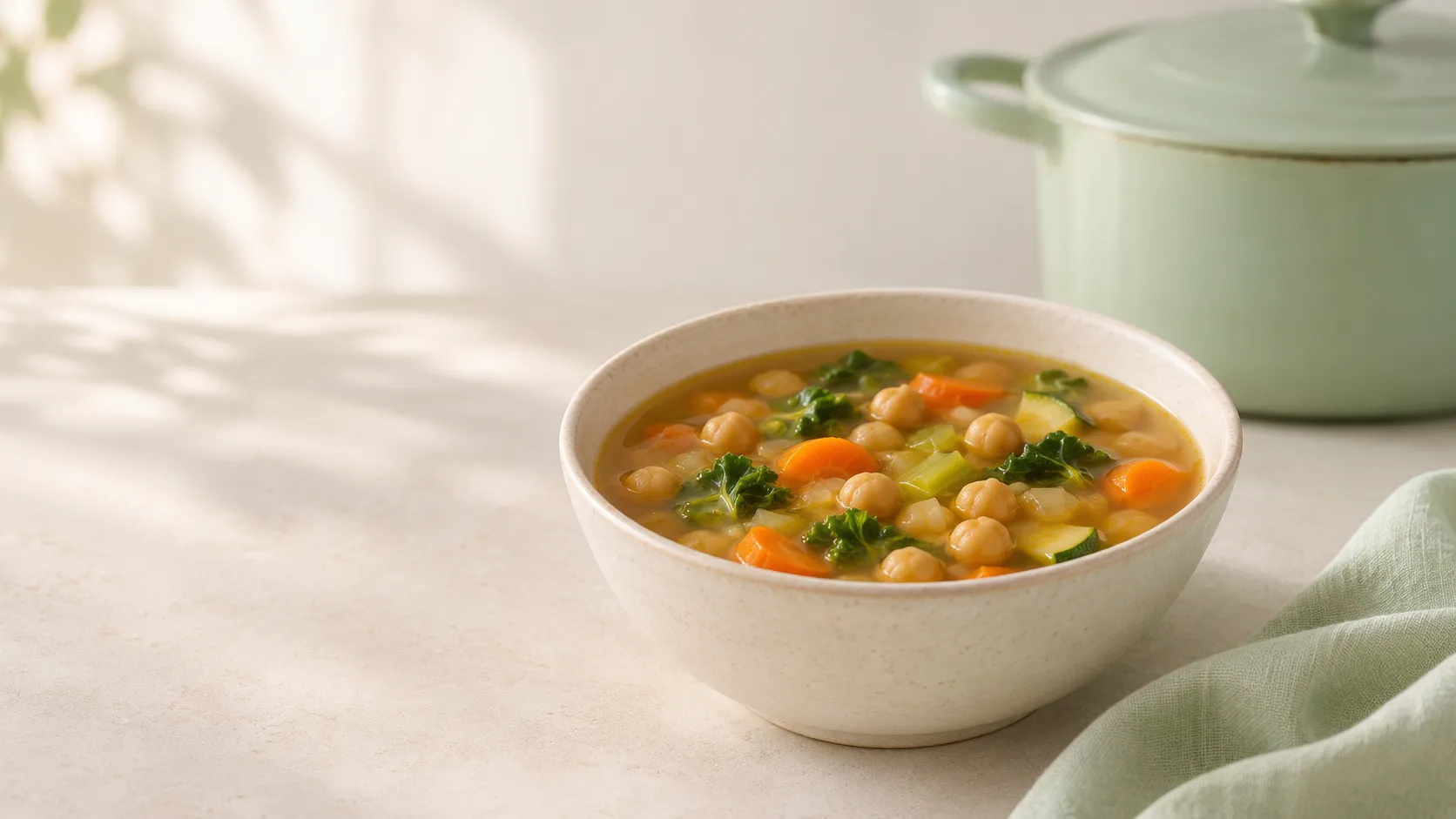
Add the calories in the ingredients that remain in the soup, then weigh the finished food without the pot. For a reasonably even mixture, multiply the total by your bowl’s weight divided by the batch weight. A bowl with mostly broth or mostly solids may not match that average.
Count what stays in the pot
Use matching labels or database entries for the ingredients you add. Include oil and any stock, milk, cream or sauce with calories. Plain added water does not contribute calories, but it changes the finished weight.
Record the food state too. Chickpeas weighed after boiling need a cooked-chickpea entry. Vegetables weighed before cooking need entries that match that starting state. If you discard fat, broth or solids, the starting ingredient sum may no longer describe what remains.
Work through one hypothetical pot
This model reuses the documented ingredients from our homemade-meal calculation. USDA SR Legacy supplies the nutrient values. The chosen ingredient amounts, added water and final weight are assumptions, not a recipe test.
| Ingredient | Amount used | kcal per 100 g | Calories added |
|---|---|---|---|
| Boiled chickpeas without salt | 250 g | 164 | 410 kcal |
| Raw carrots | 150 g | 41 | 61.5 kcal |
| Raw broccoli | 200 g | 34 | 68 kcal |
| Olive oil | 10 g | 884 | 88.4 kcal |
| Plain water | 1,000 g | 0 | 0 kcal |
| Total | 1,610 g before cooking | — | 627.9 kcal |
Suppose the finished soup weighs 1,400 g, excluding the pot. The model assumes all calorie-containing ingredients remain and only water is lost. A representative 350 g bowl is one quarter of the finished soup:
627.9 × 350 ÷ 1,400 = 156.975 kcal
That is about 157 kcal. A representative 500 g bowl would be 224.25 kcal, or about 224 kcal. The starting 1,610 g is not the denominator after the assumed water loss.
Broth and solids make the average less reliable
The fraction method assigns the same calories per gram to every part of the pot. That fits a smooth, uniform soup better than a bowl with an uneven share of beans, vegetables and broth.
Stir before portioning and distribute the solids as evenly as practical. For meal prep, share the solids among the containers, then distribute the liquid. This can make portions more representative, but it does not prove identical nutrient content.
If your bowl is mostly broth while the pot is mostly beans, its weight alone cannot tell you its calories. Do not treat the batch average as an exact answer. If ingredients are portioned separately and you know their amounts, calculate those components separately. Otherwise keep the uncertainty with the entry.
Weigh food without putting a hot pot on the scale
Use a container and method allowed by your scale’s instructions. Avoid overloading it with a heavy pot and food. You can transfer the soup into suitable containers, subtract each empty-container weight and add the food weights. Keep the units in grams throughout this calculation.
A cup is a volume measure. Do not substitute a number of cups for grams without a conversion established for your soup. The ratio method can use measured volumes only when both measurements describe a sufficiently uniform mixture in the same volume unit.
Try the portion calculation
The tool starts with its separate example. To reproduce this soup model, replace the fields with 627.9 kcal, 1,400 g finished food and 350 g portion. It should show about 157 kcal. Change the portion to 500 g to see about 224 kcal.
Without JavaScript, use the written formula above. The figures describe this model only, not a recommended portion or a calorie target.
Save the batch and the bowl separately
Keep the batch total and finished weight with the recipe. Record only the portion you ate in your diary, with toppings added separately when they were not included in the pot.
Nourmio can keep calories and total sugar in one entry. A calorie calculation alone does not establish the soup’s total sugar.