 Nourmio
Grams vs. milliliters on a kitchen scale
Find out when to weigh food in grams and when to measure in milliliters. Compare spoonfuls of honey and olive oil and calculate calories from a volume label.
Grams measure mass, and milliliters measure volume. Two foods can fill the same 15 mL tablespoon and weigh different amounts. Match your measurement to the unit on the label. If it only gives milliliters, use a measuring spoon or a reliable volume-to-weight value for that food.
Compare two foods in the same spoon
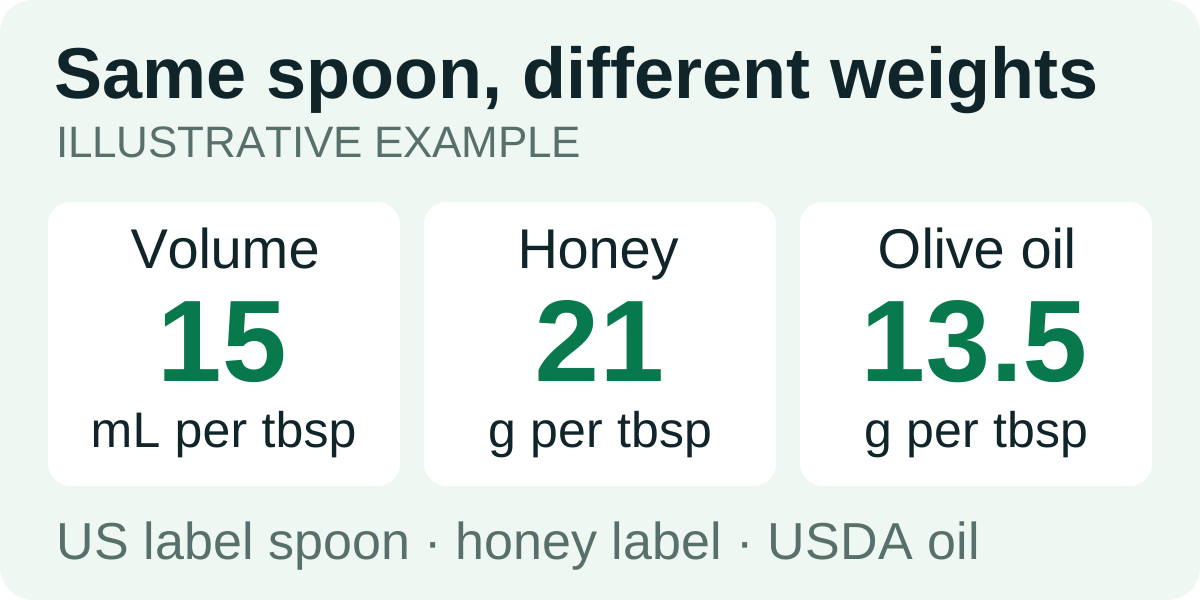
A tablespoon on a US nutrition label means 15 mL. The Kirkland Wild Flower Honey label lists 21 g per tablespoon. The USDA reference for olive oil lists 13.5 g for a tablespoon. Those two figures are label and database values for specific foods. Use the information on your own package when you have it.
Use the same unit on both sides of the calculation
| What your label gives | What to measure |
|---|---|
| Grams per serving | Weigh the amount in grams. |
| Milliliters per serving | Measure the volume with a marked spoon or cup. |
| A volume with its weight, such as 1 tbsp (21 g) | Use the matching pair for that food. |
For example, Bertolli Smooth Taste olive oil lists 120 kcal per 15 mL. If you measure 10 mL, calculate 120 × 10 ÷ 15 = 80 kcal. If your scale shows 10 g, the calculation above does not apply to that reading. The panel’s 14 g of total fat is the declared amount of fat, so it does not provide a weight for the entire serving.
Check what your scale means by mL
The Etekcity Luminary specifications list separate milliliter modes for water and milk. Check your own model’s manual before using its volume display. For oil, syrup or a different liquid, a marked spoon is a straightforward choice when the panel only gives volume.
If you can match grams directly, tare the bowl or cup before weighing and enter the weight you measured. Save the label basis with a regular ingredient so you can repeat the same entry next time.