 Nourmio
How to count dry pasta calories in a cooked batch
Match dry or cooked nutrition data to your weighing step, then use your own cooked yield to calculate the pasta on your plate.
For a shared batch of plain pasta, start with the dry amount and matching dry nutrition data. Weigh the cooked, drained batch, then multiply its estimated calories by the fraction you ate. Keep dry and cooked weights separate. A generic cooked-food entry describes a different reference, not your pot’s measured yield.
Choose a nutrition entry that matches the weight
If you weigh dry pasta, use the package’s dry-pasta information or a matching dry database entry. If you weigh cooked pasta and have no dry batch record, use a suitable cooked entry. Do not multiply cooked grams by a dry-food value.
Check the package wording rather than assuming every pasta product uses the same basis. Fresh, filled and ready-to-eat pasta can have different ingredients and preparation instructions. A label serving is a reference for its nutrition figures, not a recommendation for how much you should eat.
For a database example, USDA SR Legacy lists 371 kcal and 2.67 g total sugar per 100 g for enriched dry pasta, FDC 169736. Its cooked enriched pasta without added salt, FDC 169737, has 158 kcal per 100 g. Those are separate reference records. Their ratio does not establish how much water your own pasta absorbed.
Use your batch’s cooked weight
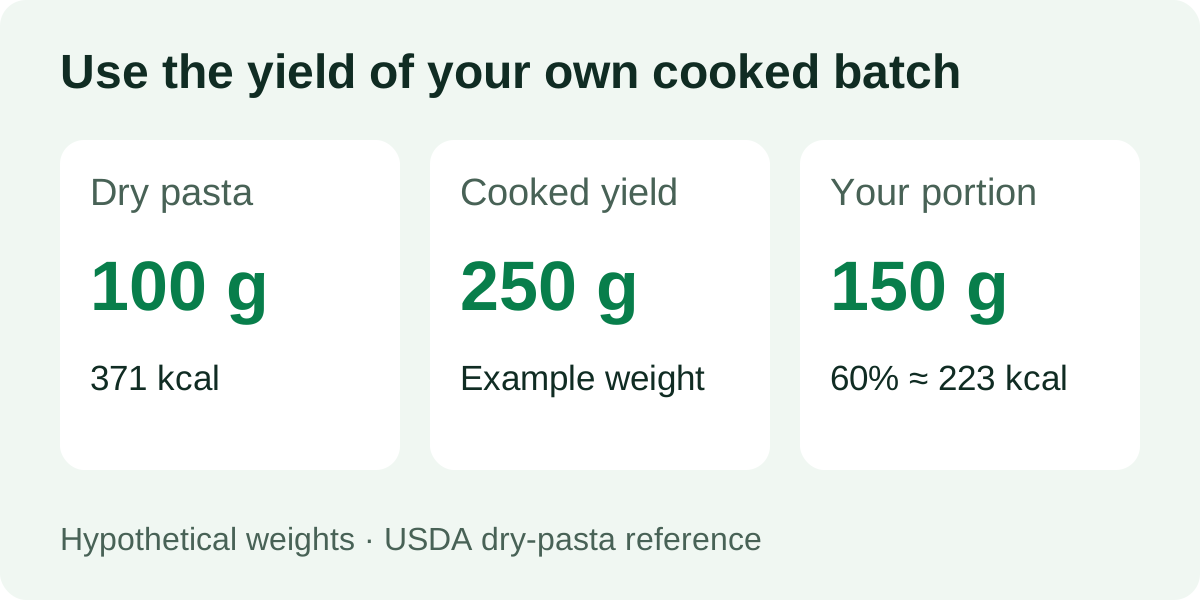
The example below uses the dry USDA reference. All food weights are hypothetical. We did not cook or measure the pictured pasta.
| What you record | Example amount | How it is used |
|---|---|---|
| Dry pasta | 100 g | 371 kcal and 2.67 g total sugar from the dry reference |
| Cooked, drained pasta, without the container | 250 g | Finished weight for this example only |
| Cooked pasta you eat | 150 g | 150 ÷ 250 = 60% of the batch |
| Estimated amount eaten | 222.6 kcal, 1.602 g sugar | 60% of the starting nutrients |
For a diary, that is about 223 kcal and 1.6 g total sugar. This model assumes the starting nutrients remain in the drained pasta and the portion represents the batch. It does not measure nutrients lost into the cooking water. The decimal places show the calculation, not laboratory accuracy.
Weigh your own drained batch if you follow this method. Substituting a standard cooked weight changes the fraction and can make an otherwise correct calculation describe the wrong portion.
Add the sauce at the stage you weigh it
If you weigh plain pasta and add sauce to your plate, log the sauce separately. Include oil, cheese and other toppings too.
If you mix sauce into the whole batch before weighing it, use the combined ingredient total and combined finished weight. Do not divide the pasta-only calories by a pasta-and-sauce weight. The two inputs would describe different foods.
The recipe nutrition calculator can handle a full ingredient list. For the background on matching food states, see raw and cooked food weights.
Keep the preparation in the saved name
Record “cooked plain pasta from 100 g dry batch” rather than just “pasta.” Keep the finished weight with your calculation so you can see when a new batch needs a new value.
In Nourmio, enter the portion’s calories and total sugar together. Check any barcode result against the package and the state you weighed.