 Nourmio
A one-week food diary template with portions and notes
Copy a seven-day food log that keeps portions, calorie and sugar references, and uncertainty together. Includes a filled example and a reusable entry form.
Use one row per food or drink and record its amount, preparation and nutrition reference. Keep calories and total sugar beside the portion they describe. Leave an unknown value blank with a note rather than turning it into zero. The copyable weekly sheet below helps you retain those details without treating a diary as a medical assessment.
Copy the week, then add rows as you need them
CDC’s food-and-beverage diary uses a weekly layout with spaces for meals and snacks. The original worksheet below adds portion and reference fields for someone who wants to keep a calorie and total-sugar record. It is a Nourmio worksheet, not a reproduction of the CDC form or an endorsed clinical tool.
Copy the table into a document, spreadsheet or notebook and write the dates next to the days. Add a row for each food or drink. Keep each amount and nutrition reference on the same row so you can check the day’s total later.
For a spreadsheet, download the CSV template. It has a blank row for each day. Duplicate a row for each food or drink and fill in your own dates. Empty calorie and sugar cells stay empty until you have a value to enter.
| Day and date | Foods and drinks, with time | Amount and preparation | Nutrition reference | Calories / total sugar | Notes or unknowns |
|---|---|---|---|---|---|
| Monday: ______ | ______ | ______ | ______ | ______ | ______ |
| Tuesday: ______ | ______ | ______ | ______ | ______ | ______ |
| Wednesday: ______ | ______ | ______ | ______ | ______ | ______ |
| Thursday: ______ | ______ | ______ | ______ | ______ | ______ |
| Friday: ______ | ______ | ______ | ______ | ______ | ______ |
| Saturday: ______ | ______ | ______ | ______ | ______ | ______ |
| Sunday: ______ | ______ | ______ | ______ | ______ | ______ |
There is no preset calorie target, sugar limit or score in this sheet. It records what you choose to log. It does not decide how much you should eat or diagnose a nutrition problem.
Use the same entry form for each item
The following text is selectable and works without JavaScript. Copy it for each food or drink.
Date and time:
Food or drink:
Amount eaten, with unit:
Preparation (raw, cooked, drained, or other):
Package or recipe reference, with serving basis:
Calories for this amount:
Total sugar for this amount:
What is estimated or unknown:
A useful reference is “package: 120 kcal and 6 g total sugar per 40 g,” not just “label.” For a homemade dish, retain its ingredient total and finished weight. That lets you check a changed portion later instead of starting again from memory.
See how one filled entry differs from a guess
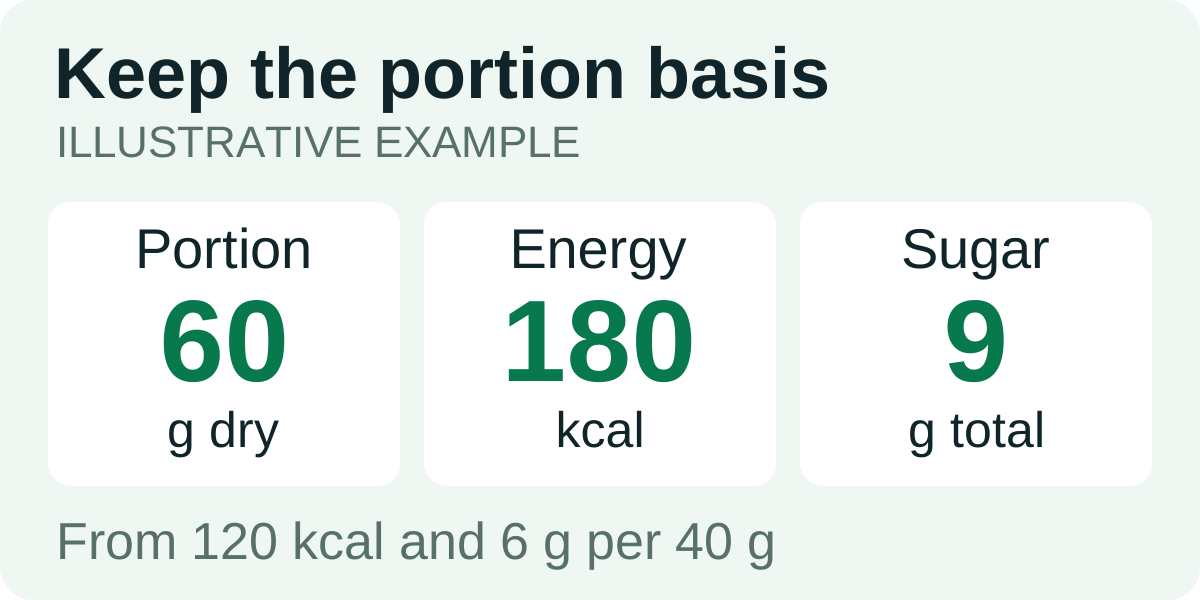
Here is an invented entry to show the arithmetic. It does not describe a real person’s day or an actual product.
| Field | Example |
|---|---|
| Date and time | Your Monday date, 08:00 |
| Food | Example dry cereal |
| Amount eaten | 60 g |
| Reference | Hypothetical package: 120 kcal and 6 g total sugar per 40 g |
| Calories for the amount | 120 × 60 ÷ 40 = 180 kcal |
| Total sugar for the amount | 6 × 60 ÷ 40 = 9 g |
| Note | Milk not included in this cereal entry. Add it separately if used. |
For a restaurant meal without a suitable reference, write the meal and portion description, then mark the nutrition value as estimated or unknown. A precise-looking number is not more useful when its basis is missing.
Check gaps before adding daily totals
A blank row can mean you have not entered the meal, that you did not have that meal, or that the nutrition value is unavailable. Use a short note to make the distinction. Zero is appropriate only when that is the value you intend to record, not as a replacement for missing information.
Before totaling a day, check for drinks, add-ins and entries copied twice. If some calorie or sugar values remain unknown, call the sum a total of the known entries. Do not label it a complete day’s intake.
Keep this record private where possible. You do not need to add your name, body measurements or other personal details to use the worksheet. Share it only for a purpose you choose.
Move a checked entry into your diary
If you prefer to log in Nourmio, save the checked amount, calories and total sugar there. Keep the package or recipe details so a repeated meal can be reviewed when its ingredients change. See logging repeated meals for that distinction.
At the end of the week, identify entries whose references you want to improve next time. The sheet can show what is missing from the record. It cannot establish a medical result or prove that a calorie target was suitable.