 Nourmio
Is AI calorie counting accurate? A dated 507-dish test
Read a reproducible October 22 photo test: 507 attempts, 506 estimates, calorie errors and the limits of applying a cafeteria dataset to your meals.
An AI calorie estimate can be wrong even when the food name looks right. In a Nourmio photo test run on October 22, 2026, 506 of 507 Nutrition5k dishes produced a usable estimate. Across those 506 results, the mean absolute calorie error was 75.3 kcal. This is evidence about that dated test, not a guarantee for your meal.
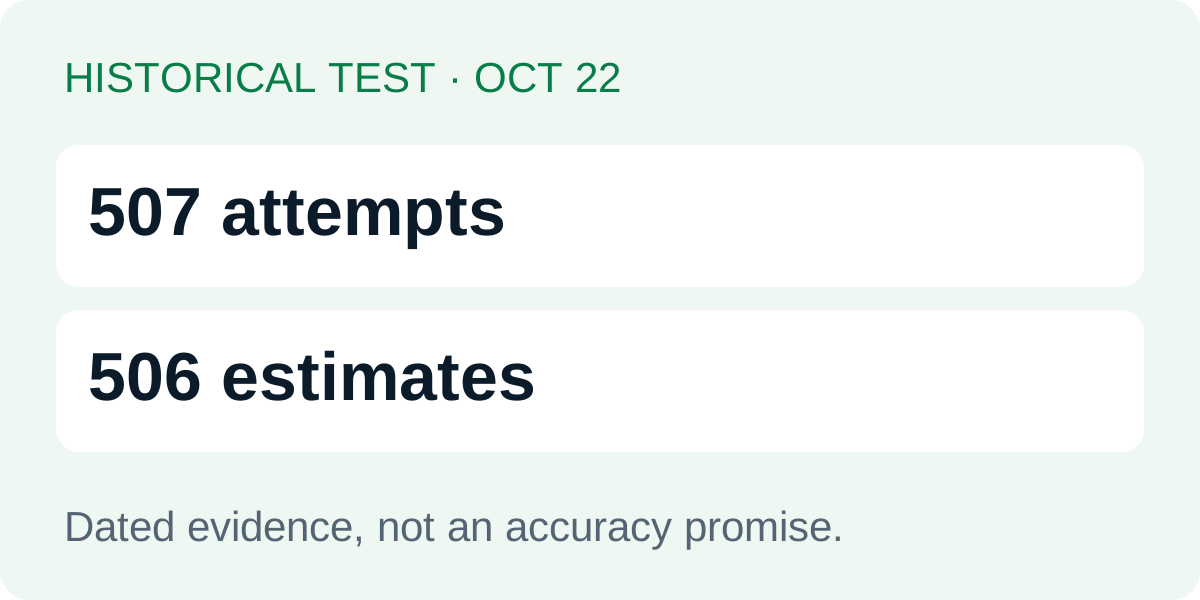
Programmatically drawn explanatory diagram. The examples and source limitations are explained below.
What this test actually used
The test used all 507 dishes in Nutrition5k’s official depth-test list. The recognition system received a single overhead color image for each dish, without the reference calories, reference weight or depth data. We scored the first returned food candidate using the application’s calorie calculation.
The model identifier was google/gemini-3-flash-preview, accessed through RouterAI. The test used the production recognizeImage path saved at the time. There were no terminal retries to replace an unsuccessful result with a better one.
Nutrition5k was collected in a small number of California cafeterias. Its researchers recorded ingredient weights and used food-composition information to calculate nutrition references. Those references are not direct chemical measurements of each plate’s calories.
The dataset’s authors also warn that it does not cover every cuisine. An official test split does not establish that these meals represent your kitchen, your camera or the mix of foods you log.
Read coverage separately from error
The application returned a usable first candidate for 506 dishes. For the remaining dish, the provider returned no candidates, so the application had no usable estimate.
That dish, dish_1557861216, has a dataset reference of 0 kcal and 1 g. We kept the prediction missing. We did not replace it with zero after seeing the reference, or call it a correct zero-calorie prediction.
The error metrics below therefore use 506 results. All 506 have positive reference calories. “506 out of 507 produced an estimate” describes coverage. It does not mean the estimates were 99.8% accurate.
Understand what the calorie errors mean
| Metric | Result | How it was calculated |
|---|---|---|
| Attempts | 507 | Every dish in the selected official test list |
| Usable estimates | 506 | First candidates available for scoring |
| Mean absolute error | 75.3 kcal | Average absolute distance from reference calories |
| Mean absolute percentage error | 39.9% | Average of each dish’s absolute error divided by its reference |
| Absolute error relative to total reference calories | 29.4% | Sum of absolute errors divided by sum of reference calories |
| 90th-percentile absolute percentage error | 76.1% | Nearest-rank percentile across the 506 per-dish percentage errors |
Mean absolute percentage error gives every dish equal weight. The ratio of summed absolute errors to summed reference calories gives more weight to dishes with more reference calories. A large percentage error on a small meal can therefore affect the per-dish average strongly, while contributing less to the aggregate ratio.
Neither percentage should be subtracted from 100 and advertised as a single accuracy score. The 75.3 kcal mean is also not a promise that every estimate stays within 75.3 kcal.
For an invented illustration, an estimate of 300 kcal against a 400 kcal reference has a 100 kcal absolute error and a 25% absolute percentage error. This illustration explains the metric. It is not a selected test result.
Inspect every result
The downloadable table includes all 507 dish IDs, reference values, predictions and statuses. The failed prediction stays null. The chart shows the 506 usable calorie estimates against their reference values, with a diagonal for an exact match.
The accompanying method note records the dated model, selection, denominator rules and source hashes. The numerical tables can be recalculated offline without calling the model again.
Nutrition5k data is credited to Quin Thames and colleagues at Google Research and distributed under CC BY 4.0. The table here combines its reference values with the saved Nourmio test predictions. We have not republished the dataset’s food photographs.
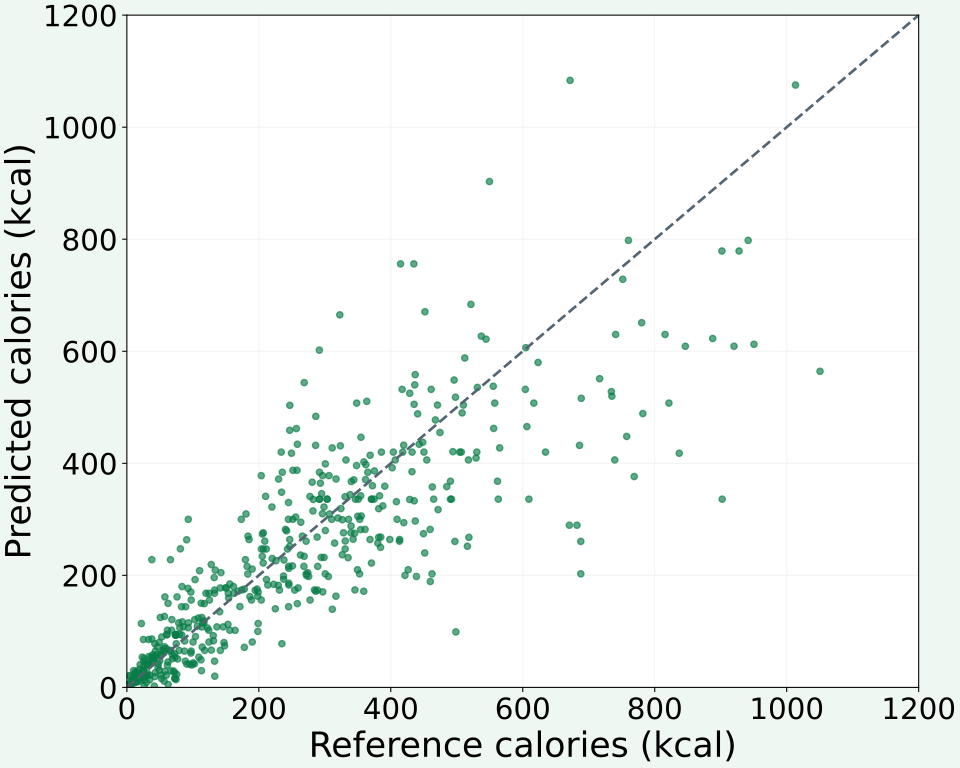
October 22 historical test. Each point is a usable result, not a measured meal from a current app user.
Download all 507 numerical results (CSV text) · Read the method and reproduction notes
What this result does not establish
We do not know whether the provider’s model had previously seen Nutrition5k images. Using the dataset’s official test split does not establish that the images were absent from the model’s pretraining.
The test does not measure total-sugar accuracy. Nutrition5k does not provide the sugar reference needed for that claim. Calorie error cannot be used as a substitute for sugar error.
It also does not establish the current provider’s behavior or the accuracy of all present app results. A source comparison on October 30 found the same product-service code after accounting for line endings. Reprocessing the saved responses reproduced the stored results. Neither check reran the provider on new food.
No independent iPhone capture study or evaluation across every cuisine is included. We did not use these results to compare Nourmio with nutritionists or claim a medical outcome.
Use the estimate as an entry you can check
Before saving, check the food name, cooking method and amount. Add information the picture cannot establish, such as a package label or a measured sauce amount.
If a matching label gives you the nutrition directly, use that information rather than treating a photo guess as stronger evidence. Our homemade-meals guide shows how known ingredients and a finished batch can support a transparent portion calculation.
Nourmio lets you review portions and nutrition details before saving. Use that review for the meal in front of you, even when a benchmark result looks encouraging.