 Nourmio
How to count calories without weighing food
Use package amounts, matching pieces and household measures to estimate a meal. See what each method can establish and when a photo remains a guess.
You can estimate calories without a food scale by using the package amount, counting matching pieces, or measuring with a cup or spoon. Use the most specific information you have. A visual guess remains a guess, even when an app prints a precise number.
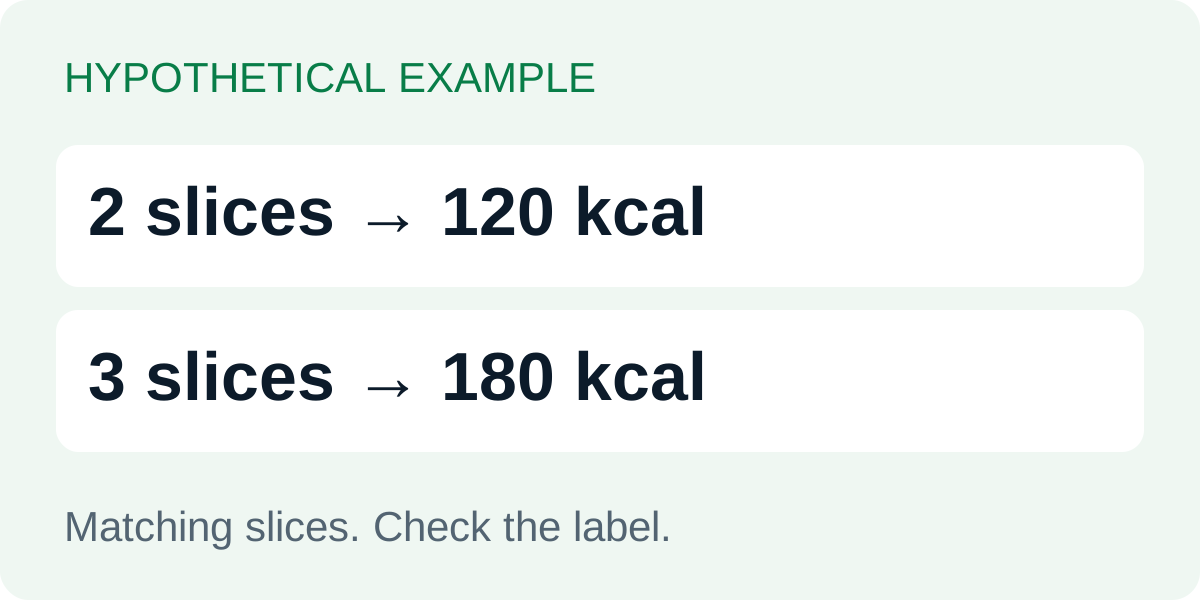
Programmatically drawn explanatory diagram. The examples and source limitations are explained below.
Choose a method that matches the food
An unopened single-serving package gives you a known packaged amount. If you eat the whole thing, use the nutrition for that package. A larger package can contain several servings, so check the serving count before copying its calories.
For slices or crackers, look for a label that names a number of pieces. Use a measuring cup or spoon when the label uses that same measure. Your usual mug or dinner spoon may hold a different amount.
A hand or plate can help you describe a portion. It cannot tell you a universal weight for everything that fills the space. A loosely filled cup of leaves and a cup of dense dressing are different foods with different calorie values.
Work through a label example
Suppose a bread label lists two slices and 120 calories. These are invented practice numbers. Three matching slices are 1.5 label servings, so the calculation is 120 × 1.5 = 180 calories.
That calculation assumes the slices match the ones described on the label. A thick hand-cut slice, an end piece and a slice from a different loaf need another check. The arithmetic can be exact while the amount you put into it is approximate.
For a uniform food, a fraction of the package can also help. Imagine a 240 g package with 150 calories per 60 g. Half the package is two label servings, or 300 calories. This is a worked example, not a measured lunch.
The fraction method is less useful when you take mostly one component from a mixed package. Half the volume of a salad kit does not establish that you ate half its dressing, cheese and leaves.
At a restaurant, check what the menu number includes
Use published nutrition for the matching item and size when it is available. FDA explains that covered chains display calories for standard menu items. This does not mean every restaurant has a calorie value for every custom order.
Check the sides, dressing, drink and substitutions. If a meal’s calorie figure already includes a sauce, adding that sauce again counts it twice. If you ordered it separately, it may need its own entry.
When the restaurant has no matching information, describe the food and the amount you remember. Record an uncertain portion as an estimate rather than a measured gram weight. Revise it if better information becomes available.
Use a photo to remember the meal
Photograph the whole plate before eating, including separate sauces and drinks. The photo can preserve details you might forget later. It does not reveal the weight of the food or the amount of oil mixed into a dish.
A photo estimate in Nourmio is a starting entry to review. Check the food name, preparation and amount. Replace a guess with a package value or a measured amount when you have one.
Save a description you can use again
For a meal you repeat, keep the product name and serving basis with your calculation. “Three slices from this loaf” is easier to check next time than “180 calories of bread.”
Change the entry when the bread, slice size or toppings change. Our guide to repeated meals explains that review. If you later weigh a homemade batch, use the ingredient-to-portion method instead of keeping the old visual guess.
Nourmio can keep the amount and nutrition details you confirm in your food diary. Use the evidence available for this meal, then review the entry before saving.